 International Bass Fishing™
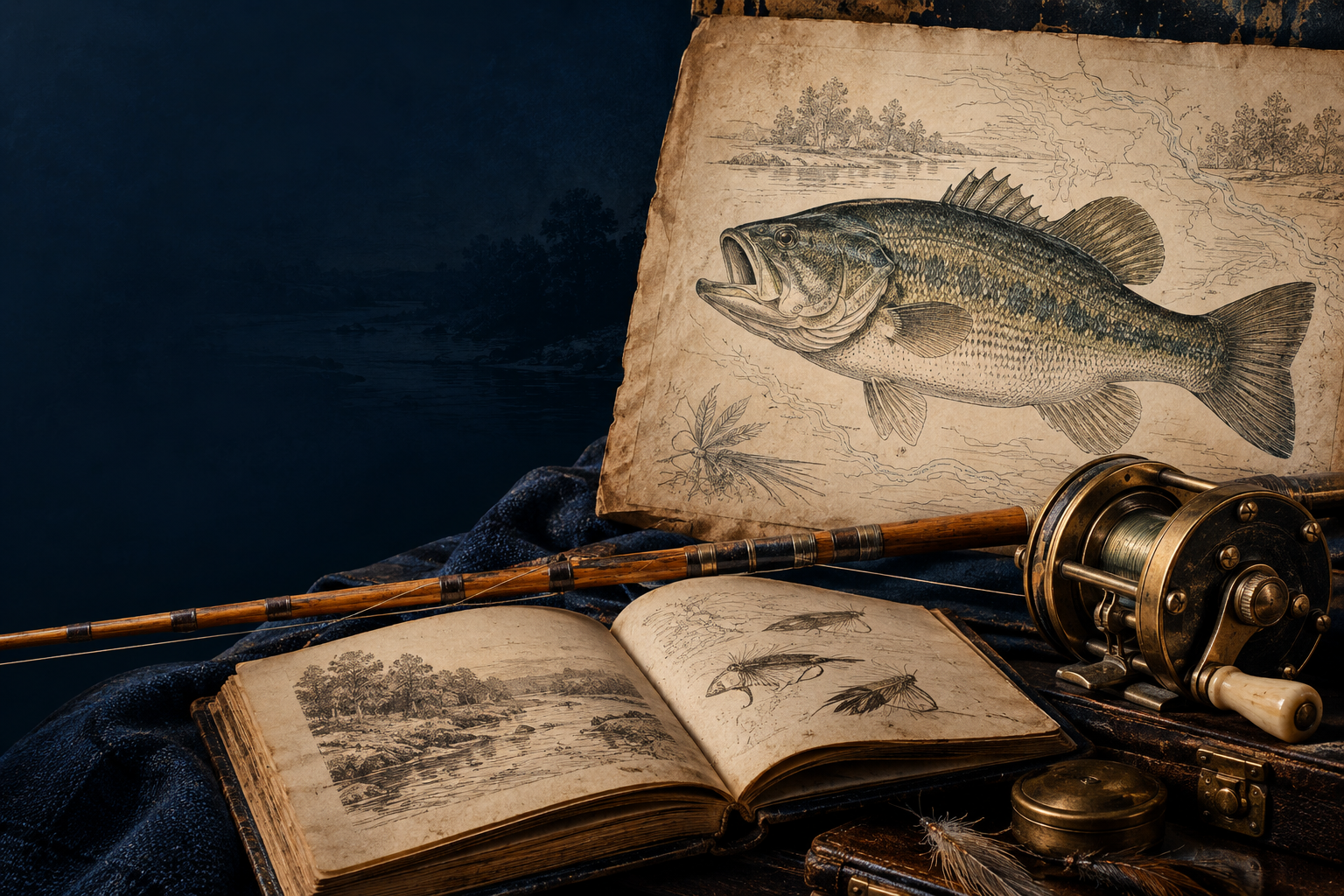
Original IntlBass historically inspired editorial illustration; not a reproduction of a specific archival photograph, book plate or tackle model.
THE HISTORY LIBRARY / BOOKS & EARLY ANGLING
Long before a tournament stage, a televised weigh-in or a digital fishfinder became part of bass fishing, an angler could open a book that tried to explain the fish, the tackle and the practice together. James A. Henshall’s Book of the Black Bass, published in Cincinnati by Robert Clarke & Co. in 1881, is one such substantial record. It is valuable because it lets us examine bass fishing in the language and assumptions of a particular period, rather than imagine that today’s sport arrived fully formed.
This guide follows the original 1881 edition preserved by the Internet Archive from a Harvard library copy. Printed page numbers below refer to the book’s own pagination. A digitized reader’s image number can differ because it includes covers, blank leaves and the introductory pages. The cover artwork on this article is a new historically inspired IntlBass illustration; the linked scan is the historical evidence.
What Henshall set out to do
Henshall’s preface, dated Cincinnati, July 1881, gives a particularly useful starting point. He wanted black bass to receive greater appreciation as game fish, and he associated that goal with better tackle and better information about their habits. He described the book as practical instruction, written from an angler’s perspective. That statement is a reminder to read him as an engaged participant with an argument to make, not as a neutral modern scientific review. Read the preface, printed pages v–vi.
He also explained that some chapters grew from articles he had contributed to Forest and Stream, the Chicago Field and other journals. He had rewritten and expanded those pieces for the book. The volume therefore shows a connection between periodical writing and a more organized angling reference. A modern reader will recognize the ambition: gather scattered information into a resource that makes the subject easier to understand.
It would be a mistake to make the next leap and call the book the beginning of bass fishing. A publication records and advocates activities that already exist. Henshall refers to other anglers, tackle makers and earlier naturalists throughout the volume. His work offers a window into a developing body of knowledge; it does not establish that there was no meaningful bass angling before 1881.
A library in three parts
The contents divide the book into three broad sections. The first addresses the fish; the second examines equipment; the third treats angling methods. This arrangement matters. Readers were invited to connect natural history with practical decisions, rather than treat the fish as merely a target at the far end of a line. See the original contents and chapter headings.
| Section | Useful entry points | What a historian can examine |
|---|---|---|
| The fish | Scientific history, p. 11; coloration, p. 145; geographical distribution, p. 154; stocking inland waters, p. 185 | How names, appearance, range and fish introductions were understood at the time |
| Tools and tackle | Rods, p. 195; reels, p. 237; lines, p. 252; hooks, p. 283; artificial baits, p. 307 | Construction, material choices and the functions anglers expected equipment to perform |
| Angling practice | Philosophy of angling, p. 349; fly fishing, p. 387; bait fishing, p. 409; still fishing, p. 428 | The relationship between technique, enjoyment and contemporary sporting values |
These page references provide a way to move through a long source without mistaking a brief summary for the source itself. Someone interested in reels can start with chapter X. Someone studying fish introductions should begin with the geographical discussion and then compare it with the stocking chapter. A reader interested in bass on the fly can move directly to the fly-fishing section and return to the equipment chapters as needed.
Why the fish illustrations were not printed in color
One small detail in the preface deserves attention. Henshall credited Dr. E. R. Copeland with drawing the full-page bass illustrations from life. He said he initially intended to have them lithographed in color, but abandoned that plan because coloration varied so much between different places. That explanation is part of the historical record, and it is more revealing than simply saying the book contains attractive fish pictures. Preface, printed pages v–vi.
The decision connects visual publishing with the problem of representing a living animal. A beautiful image can suggest a standard appearance even when the author knows there is variation. Henshall’s explanation shows that he considered that problem. For a present-day website, the same principle is useful: illustration can introduce a subject, but it should not quietly become a diagnostic reference or a substitute for documented specimens.
When viewing the scan, distinguish the original plates from later covers, digitization artifacts and modern artwork accompanying a discussion of the book. Our new History artwork is an editorial interpretation of the subject. It is not a claim that a particular reel, engraving or open page appeared exactly as pictured in Henshall’s own copy.
Names that seemed settled, and science that continued
Henshall devoted considerable space to the scientific naming of black bass. In the preface, he defended the names he adopted and expressed confidence that the naming confusion could be resolved. In the scientific-history chapter, readers encounter a complicated succession of descriptions, genera and interpretations. The book itself therefore makes clear that the labels attached to fish have a history. Read chapter I and the preface together.
For modern use, preserve the author’s terminology when explaining his text, then identify the current reference separately. The Florida Fish and Wildlife Conservation Commission’s July 17, 2024 announcement explains that Florida bass are recognized as Micropterus salmoides, while largemouth bass are Micropterus nigricans. That modern distinction should not be retroactively inserted into every nineteenth-century passage as if Henshall had today’s evidence. Read the FWC announcement.
There are two useful questions here. What did a particular author mean by a fish name at the time? And what does the current scientific authority mean by that name now? Those questions can produce different answers without making the old book useless. They make it necessary to label the evidence carefully. Our Bass Species Atlas is the companion starting point for current naming and source links.
The reel as a tool for a specific job
Chapter X begins its discussion of reels by relating equipment to the work it must do. Henshall separates delivering a bait from playing and landing a hooked fish, and compares multiplying reels used in bait fishing with click reels used in fly fishing. His explanation discusses the angler’s control of the spool and the problem of backlash. These are recognizable practical concerns, even though the equipment and terminology belong to the nineteenth century. See chapter X, beginning on printed page 237.
The historical interest is not that a modern angler should buy an antique reel in place of a current one. It is that tackle was already being assessed through function. Henshall asks how the reel serves the method of fishing. Reading that argument can help a collector understand why an object was designed as it was, or help a historian separate mechanical features from advertising language.
Later in the chapter, Henshall gives an account of the Frankfort reel associated with Meek and Milam. He describes a watchmaking background and praises the precision of the workmanship. This is his account and assessment, not an independent modern verification of every manufacturing detail. A responsible history article can report that Henshall made those claims while leaving room for additional maker records, museum objects and specialist research. See the multiplying-reel discussion around printed pages 245–247.
That distinction also matters when linking historical tackle to our modern gear directory. The directory helps readers find present-day manufacturers and resources. It does not establish a direct, undocumented line from every nineteenth-century mechanism to a particular current brand. Connections should come from documented maker histories, patents or surviving objects, rather than resemblance alone.
Fish introductions as historical evidence
The geographical-distribution chapter contains another important window into the period. Henshall discusses the movement of black bass into new waters and reproduces an account attributed to James W. Milner from a United States Fish Commissioner report. The passages describe introductions and stocking efforts with the enthusiasm of their era. A reader can use them to investigate how people attempted to expand fishing opportunities. See chapter V, printed pages 154–161.
Those historical accounts should be treated as leads to investigate, rather than a present-day permission to move fish or a complete map of established populations. A reported introduction, a surviving population and a contemporary fishery are separate propositions. They may require different evidence. Even a clearly dated stocking account does not by itself explain what happened to the receiving ecosystem afterward.
For present-day occurrence and introduction records, the USGS Nonindigenous Aquatic Species database is a relevant research resource. Current local fisheries agencies are also essential. Our country guides link to organizations and authorities associated with their region, while the location atlas helps readers begin place-based research. Neither a country outline nor a tournament dot should be interpreted as a species-range map.
How to read an old angling manual well
Begin with the edition. A revised edition can change wording, illustrations or coverage, so a reference to a particular page should identify the year and publisher. Next, use the printed pagination rather than relying solely on a search result or a digitized viewer’s image count. Then check any significant detail in the page image. Optical character recognition can misread names, numbers and unfamiliar typography, especially in a heavily illustrated old volume.
Read the author’s preface before extracting individual claims. Henshall tells us what he is trying to accomplish, whom he credits and what kind of book he believes he has written. Those statements help explain the tone of the chapters. They also reveal a network of journal editors, naturalists and angling practitioners around the work. The preface is evidence about the production of the reference, not decorative material to skip.
Finally, keep description, interpretation and present-day advice separate. A description says what a chapter contains. An interpretation explains why its organization or argument may matter. Present-day advice requires a current source appropriate to the question. Fishing regulations, access conditions, fish-handling guidance and species identifications should not be reconstructed solely from a manual published in 1881.
Where this book fits in the larger history
Henshall’s volume belongs in a history that includes learning, collecting, natural history, tackle making and everyday angling. Professional competition is another strand, with its own archives and institutions. Reading an early manual alongside later tournament records lets us compare different kinds of evidence without collapsing all of bass fishing into one circuit, one personality or one technology.
The best next step is to choose a question. Why were certain reel features valued? How did an author describe a fish’s range? What did a chapter assume about the purpose of angling? The original scan allows readers to test the answers, and the chapter structure makes those questions manageable. That ability to return to the evidence is what makes an old book useful for a modern reference library.
Continue through the IntlBass History Library, explore the species reference, or compare current rods and reels through our gear resources. For the historical source itself, open Henshall’s 1881 edition and start with its preface and contents.
Research note: reviewed October 10, 2026. Primary historical source: James A. Henshall, Book of the Black Bass, Cincinnati: Robert Clarke & Co., 1881, original digitized edition. Modern naming context: FWC, July 17, 2024. Artwork: original IntlBass editorial illustration. This article examines one source, not the entire history of bass fishing.