 International Bass Fishing™
Lake Fork inlet, Rains County, Texas, May 22, 2014. Carol M. Highsmith / Library of Congress, LCCN2015630125. Public domain. Historical photograph; displayed in cropped layouts.
THE DEPTH CHART / LAKE FORK, TEXAS
BIG-BASS WATER.
A SMARTER FIRST PLAN.
Where to launch, where to begin from the bank, what to tie on, and how to turn Lake Fork’s reputation into a practical fishing trip.
Access & maps ↓ · Bait playbook ↓ · The records ↓ · Your first day ↓
Lake Fork is the kind of name that makes a bass angler reach for the calendar. Its appeal is easy to understand: a famous largemouth fishery, substantial tournament history, and enough different habitat to reward careful observation. The useful question is not simply whether the lake holds big bass. It is how you will spend your own hours there.
This guide combines official access, regulation and record sources with an original planning playbook. The tactics are starting ideas, not a claim that we personally fished a spot or that a particular bite is happening today. Source review: October 14, 2026. If you are building your first setup, begin with our first-bass beginner guide and gear directory.

Lake Fork at a glance
| Where | East Texas, near Quitman; Hopkins, Rains and Wood counties. |
|---|---|
| Lake size | 27,264 acres; maximum depth listed as 70 feet. |
| History | Impounded in 1980. |
| Main focus here | Largemouth bass. See our species guide. |
| Before you launch | Check current water level, weather, access and navigation hazards. |
| Regulation to know | Lake-specific largemouth slot rules; details and official link below. |
The geographic facts above come from TPWD’s Lake Fork overview. The agency identifies timber, vegetation, docks, points and bridge-related features as part of the lake’s fishing context, and warns about submerged timber even around buoyed routes. Treat the lake as water that requires navigation judgment, not simply a collection of attractive casting targets.
Where to go: choose the access that fits your day
Public boat access
TPWD’s official access directory lists public facilities including Rains County, FM 17, SH 515 East and Highway 154. The FM 17 facility is associated with the west end of the FM 515 bridge over Lake Fork Creek; SH 515 East and Highway 154 serve the Caney Creek side. Open the facility’s own listing for directions and current details before saving a route.
Caney Point Recreation Area, operated by the Sabine River Authority, lists a six-lane ramp, loading piers and substantial trailer parking. It can be a useful facility to investigate when planning a boat day. A large ramp does not guarantee an uncrowded launch, a safe wind direction, or adequate conditions on the day you arrive.
A starting point for bank and pier anglers
W. C. Swearingen Recreation Area lists a wheelchair-accessible fishing pier, restrooms and picnic facilities near the Highway 154 bridge. It gives a shore-based visitor a concrete place to research instead of the vague instruction to “fish the bank.” Verify the facility’s current status and stay within permitted areas.
Private marinas can offer additional access and services. Confirm charges, hours, launch availability and any lodging conditions directly with the operator. For a first visit, save a primary access option and a backup before leaving home. That small step is more useful than arriving at an unfamiliar gate and hoping the next turn works out.
Use three maps for three different jobs
- Orientation: Google Maps for Lake Fork helps you understand the lake and surrounding roads.
- Access: use TPWD and SRA facility pages to choose a legal launch or pier.
- Habitat: TPWD’s fish-attractor resources and Habitat Structure Viewer provide published habitat information. A waypoint identifies a feature, not a guaranteed school of fish.
INTLBASS™ / EXPLORE THE ACTUAL WATER
Lake Fork Reservoir, Texas on Google Maps
Pan and zoom to explore the lake and surrounding communities. Google’s place map is a geographic reference, not a depth chart or confirmation of fishing permission, launch access, current conditions or safe navigation.
What bait should you use at Lake Fork?
Build a small rotation around jobs: search, pick apart a target, and slow down. The right bait is partly a question of where it must travel. An exposed-hook finesse rig that works on a clean bottom can become frustrating in a tangle of timber. A heavy cover setup can feel clumsy when the fish demand a light, subtle presentation.
| The job | Presentation to consider | What to observe |
|---|---|---|
| Find an active edge | Spinnerbait or lipless crankbait suited to the depth and cover | Where contact, follows or bites occur; whether grass or wood prevents a clean retrieve. |
| Pick apart isolated wood or shade | Texas-rigged worm or creature bait; a suitably matched jig | Fall rate, casting angle, line movement and the ability to work out of cover. |
| Give pressured fish time | Weightless stick worm; a finesse rig on cleaner bottom | Whether a longer pause or smaller profile improves the response. |
| Work a deeper feature | Depth-matched crankbait, jig or other controlled bottom-contact presentation | Actual depth, baitfish, snag risk and repeatable contact. |
| Respond to visible surface activity | A suitable topwater or baitfish-profile lure | Activity direction and the difference between chasing splashes and making a controlled presentation. |
The dependable soft-plastic job
A straight-rigged Texas-rigged worm is a useful way to learn a piece of cover. Choose a hook that fits the plastic and leaves room for the point to emerge. Use enough weight to understand where the bait is, then compare a lighter fall if conditions allow. Make several deliberate presentations from different angles before deciding a target is empty.
For a stick-worm reference, browse the Yamamoto bait catalog. For the short-plastic-and-jighead finesse category, see Z-Man’s Ned-rig range. These are category examples, not a required shopping list. A light exposed hook deserves particular caution around Lake Fork’s wood.
The moving-bait job
A moving lure can help you compare water more quickly, but speed should serve a question. Are fish reacting along the grass edge? Is the productive water on the shaded side? Does contact with cover trigger a response, or merely hang the bait? Track the useful part of the retrieve and make the next cast test it again.
Match a crankbait’s running depth to the place you intend to fish, the line and the retrieve. A manufacturer’s advertised depth is not a guarantee under every setup. Strike King’s hard-bait catalog gives examples of deep-diving profiles; inspect the individual lure’s specifications rather than buying solely because an angler mentioned a model.
The slow-down job
When a promising area has received pressure, first compare angle and pace. A longer pause can be a more meaningful change than another nearly identical color. Work the target cleanly, watch the line, and make the retrieve repeatable. If you cannot describe what you changed, the next bite will be harder to learn from.
INTLBASS / THE PRESENTATION PLAYBOOK
SEARCH → PICK APART → SLOW DOWN
SEARCH: Find an edge or an active depth.
PICK APART: Work the best target from more than one angle.
SLOW DOWN: Give the bait time before changing everything.
A seasonal framework, without pretending the calendar is a fish finder
TPWD’s lake overview discusses popular spring presentations such as spinnerbaits, plastic worms, lizards, jigs and lipless crankbaits. Its seasonal notes also mention warm-season night fishing and winter presentations. That is a useful broad framework, but a date cannot tell you the day’s water temperature, clarity or fish position.
In a warming period, compare accessible shallow cover with nearby routes to deeper water. Do not assume every pocket is at the same stage. In hot conditions, plan around comfort and safe access as well as fishing. A short morning session can be a better choice for a visitor than forcing a long, exposed afternoon.
In a cooling period, watch for forage activity and compare features that let you fish more than one depth. In cold conditions, make a manageable search, then spend time understanding contact and pace. These are planning decisions to test, not a current fishing report.
Current-report note: when reviewed October 14, TPWD’s Fork weekly-report page stated that weekly fishing reports were on hold while reporting methods were being improved. We are not presenting an archived bite as today’s conditions. Ask local operators what they are observing, then compare their report with the conditions you actually find.
The useful “secrets” are decisions you can repeat
Fish the angle, not just the object. A piece of wood can look different to a bass when the bait approaches from another direction. Before leaving a good target, compare a second safe angle and a controlled fall. Record which presentation produced the response.
Look for a small difference in a familiar stretch. An isolated gap, a change in cover, or an edge near a depth transition gives your cast a purpose. Do not turn that observation into a claim that an unnamed “secret spot” always produces. The same visible feature can be useful one day and unoccupied the next.
Use pressure as information. If other anglers are covering water quickly, consider whether a slower presentation addresses a different part of the target. Give people room. Never crowd a boat or assume that public water removes the need for courtesy.
Separate navigation from experimentation. Do not try to solve a rigging problem while moving through unfamiliar timber. Make the boat safe first, then work on the fishing problem. A confident route back to the launch belongs in the plan from the beginning.
A beginner’s first day: keep the learning area small
Choose one access area and one nearby backup. Check weather, wind and the return route, then select a slow presentation and a moving presentation suited to the cover. Your objective is to compare a few features well, not to “cover Lake Fork” in a single visit.
Spend the opening part of the trip getting comfortable: knot, drag, casting room, boat position and lure control. Work the closest useful water before making ambitious casts. If you find a bite, repeat the depth and angle before moving to something entirely different.
After a reasonable stretch without a response, change one variable. Shorten the cast so you can maintain contact, compare a slower fall, or try a nearby feature with a different depth. Keep a brief log. Three clear observations are more valuable than a long list of baits you vaguely remember trying.
A more experienced angler’s upgrade: make the pattern explainable
Ask whether a productive target has a repeatable relationship to depth, cover, light, forage or boat position. Then test a second target with a similar relationship. If the pattern fails to travel, narrow your explanation instead of assuming the lake suddenly “shut off.”
Historical tournament coverage can suggest questions worth testing. In Bassmaster’s 2025 Lake Fork lure coverage, Tucker Smith’s winning total was 127 pounds, 8 ounces over four days, with an offshore rotation among the reported approaches. Other anglers used different presentations. This is a dated competition example, not evidence of the current bite or a reason to copy a shopping list blindly.
Compare the task behind a pro’s lure choice with your own situation. A lure chosen for a specific depth, timber relationship or time window may be poorly suited to a bank angler’s reach. Take the question from the report, then build your own test.
Lake Fork records: keep the categories straight
TPWD’s Lake Fork water-body record page, showing an October 10, 2026 update when reviewed, lists an 18.18-pound rod-and-reel largemouth bass caught by Barry St. Clair on January 24, 1992. That is a record category with a named angler and date, not a typical catch expectation.
The same official resource separates methods and recognition categories, including fly fishing, junior records and catch-and-release lengths. Do not compare pounds with inches or assume every record uses the same equipment rules. Our bass fishing records hub helps keep those distinctions visible.
Read the Lake Fork rule, not a remembered statewide minimum
When reviewed October 14, 2026, TPWD’s Lake Fork regulation page stated that largemouth bass 16 inches and less, or 24 inches and greater, may be retained; only one largemouth 24 inches or greater may be retained each day. Largemouth greater than 16 and less than 24 inches fall within the protected slot. The combined daily bag for all black bass species is five. Other species distinctions are on the official page.
Bring an accurate measuring board and recheck the current rule before fishing. Tournament scoring and fish-handling instructions add another layer; they do not replace public-water regulations. Keep the official page and your organizer’s instructions available offline if mobile coverage is uncertain.
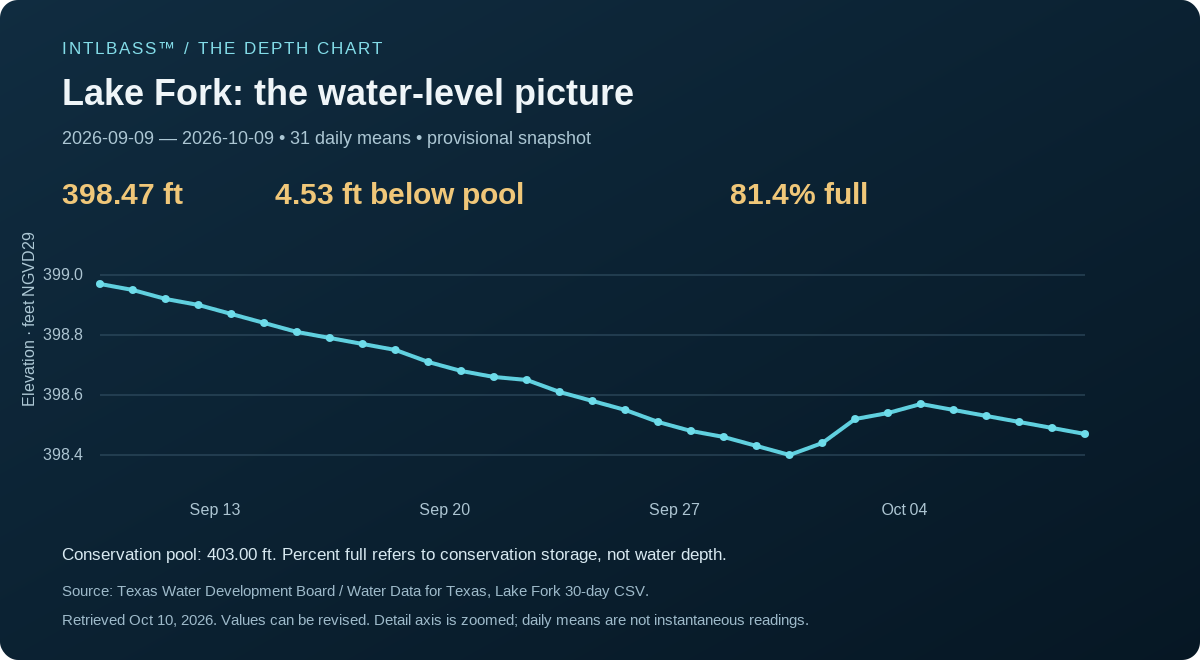
Water levels: current source, clearly dated history
Use the Texas Water Development Board’s Lake Fork page and Sabine River Authority for current water information. A useful plan asks what the level means for the chosen access and navigation route, not just whether a gauge is rising or falling.
Events, fish care and the last checks before leaving
The map below begins with Lake Fork matches in the IntlBass calendar. Open the organizer’s own page for dates, eligibility, registration and launch instructions. Our tournament hub explains the source review; event pins are approximate water locations, not verified launch coordinates.
INTLBASS / TOURNAMENT EXPLORER
EVERY CAST.
A NEW CHALLENGE.
Find your competition. Explore the water. Go straight to the organizer.
Map pins mark approximate host towns, not tournament launches. Open the organizer source for check-in and ramp details. Events without reviewed coordinates appear in the calendar only.
Know the source.
Every listed event links to its organizer. Coverage is growing. US listings include source-linked tournament imports; the official JB/NBC feed supplies Japan. International guides include dated listings where reviewed and links to local organizers. Imported events show their verification status; source reachability alone does not verify a date. Dates can change. Confirm eligibility, fees, launch and rules with the organizer before you travel or enter.
Completed events leave upcoming views automatically at their recorded end. Date-only listings remain through the final local calendar day. Historical entries stay available in Past events.
Suggest an event or report a correction →Subscribe to the IntlBass tournament RSS feed →
Prepare for a notable catch before it happens. Read the current Toyota ShareLunker program requirements if you hope to enter a qualifying fish. Recognition categories, harvest limits and tournament scoring are separate systems; check each source on its own terms.
Have release tools and a measuring board ready. TPWD’s black-bass handling guidance emphasizes suitable tackle, wet hands, careful hook removal and limiting time out of the water. Support the body for a quick photograph and avoid excessive jaw extension.
Your final checklist is straightforward: one legal access point, a backup, current weather and water information, the lake-specific rule, and a small tackle rotation you understand. Then leave space for what the day teaches you. That is how a famous lake becomes your own useful fishing story.
Discuss your Lake Fork plan on the chatboards → · Explore boats and kayaks → · Lake Fork destination page → · More Depth Chart guides →
Editorial note: expanded October 14, 2026 while retaining the original article URL and dated water chart. Facility details, regulations, record categories and reporting status are linked to their primary sources. Tactical suggestions are an original planning framework, not firsthand local guiding claims, live bite reports or guarantees. Product links identify examples rather than field-tested endorsements. Photo credit and date are shown with the image. See Editorial Standards & Disclosures.
Response
[…] then open the organizer and reservoir authority before making travel or launch plans. Our Lake Fork guide shows how access and water information fit into a complete trip […]