 International Bass Fishing™
Largemouth Bass: Identification, Habitat & Fishing Guide
BLACK BASS / CENTRARCHIDAE · Source review: October 10, 2026
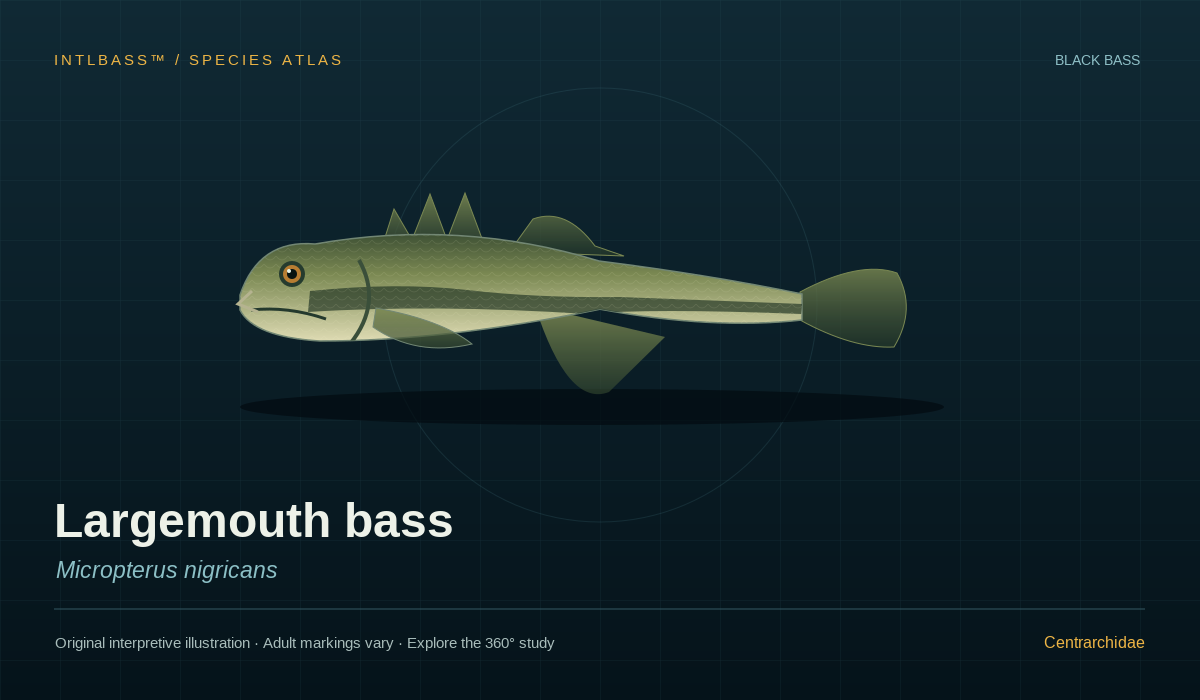
Largemouth bass are cover-oriented freshwater predators, but the familiar name can conceal an important scientific distinction. This guide uses Micropterus nigricans for largemouth bass and keeps Florida bass separate. Explore the adult-form illustration, read the identification limits, and use the source-linked regions to plan further research.
INTLBASS™ / 360° FIELD STUDY
Largemouth bass
Micropterus nigricans · Centrarchidae
Drag to orbit · Scroll or pinch to zoom · Arrow keys rotate · Shift + arrows move · R resets
Comparison uses equal illustrated body length, not actual adult size.
Loading the interactive illustration…
Older sources may use M. salmoides broadly. Appearance cannot reliably separate Florida bass and hybrids.
Illustration accuracy & sources
Original IntlBass 3D artwork with source-informed silhouette, fin layout and representative adult markings. This is an interpretive illustration, not a specimen scan, measured anatomical reconstruction, genetic test or identification key. Fin-ray counts, teeth, sex, age, regional forms and fine-scale proportions are simplified. Individual colors and markings vary. Largemouth and Florida bass deliberately share closely similar anatomy.
- FWC · 2024 scientific-name update ↗
- TPWD · Largemouth biology (older naming) ↗
- USGS · Largemouth profile and occurrence database ↗
Source review: October 10, 2026. Text and maps below explain identification limits.
At a glance
- Scientific name
- Micropterus nigricans
- Family / group
- Centrarchidae / Black bass
- Habitat
- Lakes, ponds, reservoirs and slower river habitats with cover.
- Distribution context
- Broad native North American range; widely introduced elsewhere.
- Food & life stage
- Fish and larger invertebrates; small juveniles begin with smaller prey.
- Reproduction
- Male-guarded shallow nests; timing varies with latitude and local conditions.
Identification cues
- Upper jaw reaches behind the eye when the mouth is closed.
- Dark lateral band, often broken into blotches.
- Deep notch between the spiny and soft dorsal sections.
Older sources may use M. salmoides broadly. Appearance cannot reliably separate Florida bass and hybrids.
Identify the fish before comparing the record
The jaw extending beyond the rear of the eye, the lateral band and the deep dorsal-fin notch are useful largemouth-type cues. They do not establish Florida ancestry or exclude a hybrid. Color changes with the fish, water and viewing conditions; a photograph or our illustration cannot supply a genetic identification.
FWC’s July 2024 naming explanation assigns M. salmoides to Florida bass and M. nigricans to largemouth bass. Older references, including some fisheries profiles, use M. salmoides more broadly. When a historic record uses “largemouth,” preserve that original label and the authority’s category instead of assigning ancestry from the lake’s location.
Read cover as habitat
TPWD’s biological account describes a freshwater predator associated with lakes, reservoirs, ponds and slower river habitat. Vegetation and other cover can connect feeding opportunities with shelter. Adult diets include fish and larger invertebrates; young fish use smaller prey. Male nest guarding makes reproduction part of the habitat story, with timing dependent on the water and region.
That biology gives an angler useful questions rather than a universal lure prescription: where does cover meet an accessible feeding edge, what prey is locally present, and can a presentation reach that water without snagging or disturbing a restricted area? A basemap cannot answer underwater-depth, ownership or seasonal-closure questions. Pair it with a local fishery report and the water manager’s current information.
DISTRIBUTION / SOURCE-LINKED REGIONS
Put the biology on the map.
Approximate reference regions described in the linked sources. Pins are geographic orientation points, not verified fish sightings, fishing spots, launches or complete range boundaries.
Broad drainage reference in the USGS native-range account, not a fish sighting.
Read the evidence ↗General basin orientation; tributaries differ in habitat and access.
Read the evidence ↗Broad regional reference. Review local species/genetic and fisheries records.
Read the evidence ↗From the first cast to a repeatable pattern
Start here: Choose documented public access and a manageable piece of shoreline. Learn one presentation you can cast, retrieve and remove from cover reliably. Read the rod’s lure-weight range and the line requirements for that setup. An expensive lure cannot compensate for fishing an inaccessible or unsuitable piece of water.
Build the next skill: Compare the edge of cover with adjacent open water. Change one thing at a time—retrieve speed, target angle or running depth—and record the difference. Keep a lure that contacts cover distinct from one that works above it. Note whether an apparent pattern repeats in another similar area.
Advanced practice: Separate a useful habitat pattern from a single lucky catch. Record location context, weather, water clarity, presentation, effort and a comparable time window. Revisit when conditions change. Where electronics are appropriate, check your event’s equipment rules and the chart’s actual coverage; our species map supplies regional orientation only.
These are editorial practice suggestions based on the habitat and feeding context above, not measured catch-rate claims or a promise of success. A guide for a particular water takes priority over a generic seasonal calendar.
Follow the lake, the measurement and the authority
Use our location directory for access and fishery references, including Lake Fork, Jordan Lake and Lake Norman. A stocking program or introduced population does not establish the species’ native range. The USGS occurrence account distinguishes geographic evidence that should be read with its date and naming convention.
Explore records and their sources, then confirm the originating authority’s current entry. Weight records, catch-and-release length records and line-class records measure different achievements. A biological maximum, an angler’s report and a certified record also have different evidentiary meanings.
KEEP EXPLORING
Different fish. Connected stories.
 Black bass
Florida bass
Micropterus salmoides
A distinct species, a famous trophy fish, and a naming story worth getting right.
 Black bass
Spotted bass
Micropterus punctulatus
Rows of flank spots—and an identification trap with Alabama bass.
 Black bass
Smallmouth bass
Micropterus dolomieu
Bronze flanks, rocky water and a different habitat story.