 International Bass Fishing™
Florida Bass: Identification, Habitat & Fishing Guide
BLACK BASS / Centrarchidae · Source review: October 10, 2026
A distinct species, a famous trophy fish, and a naming story worth getting right. This guide distinguishes identification, habitat and distribution evidence, then connects them to practical fishing questions. Explore the original 360° adult-form illustration, map references and the linked fisheries or scientific sources.
INTLBASS™ / 360° FIELD STUDY
Florida bass
Micropterus salmoides · Centrarchidae

Drag to orbit · Scroll or pinch to zoom · Arrow keys rotate · Shift + arrows move · R resets
Comparison uses equal illustrated body length, not actual adult size.
Loading the interactive illustration…
This model shares largemouth-type anatomy intentionally. A darker color is not proof of Florida ancestry.
Illustration accuracy & sources
Original IntlBass 3D artwork with source-informed silhouette, fin layout and representative adult markings. This is an interpretive illustration, not a specimen scan, measured anatomical reconstruction, genetic test or identification key. Fin-ray counts, teeth, sex, age, regional forms and fine-scale proportions are simplified. Individual colors and markings vary. Largemouth and Florida bass deliberately share closely similar anatomy.
Source review: October 10, 2026. Text and maps below explain identification limits.
At a glance
- Scientific name
- Micropterus salmoides
- Family / group
- Centrarchidae / Black bass
- Habitat
- Warm freshwater lakes, wetlands, reservoirs and covered shoreline habitats.
- Distribution context
- Florida and a broader southeastern native range; stocked populations also occur outside it.
- Food & life stage
- Largemouth-type predator; fish and invertebrates change with life stage.
- Reproduction
- Nest-building black bass; Florida spawning can span winter into spring.
Identification cues
- Large mouth with upper jaw extending behind the eye.
- Green-to-olive back and dark lateral markings.
- Closely resembles largemouth bass; genetics may be needed.
This model shares largemouth-type anatomy intentionally. A darker color is not proof of Florida ancestry.
Understand the identity and its limits
Florida bass and largemouth bass are closely similar black bass. FWC’s 2024 naming update places Florida bass under Micropterus salmoides and largemouth bass under M. nigricans. That distinction matters when reading older stocking reports, scientific papers and record categories. A southern lake, a dark fish or a large catch does not establish Florida ancestry. Hybrids further complicate visual identification; the illustration deliberately avoids pretending that a different paint color supplies a genetic test.
Connect the biology to the water
Warm freshwater habitat and shoreline cover provide the practical starting point. Use the Florida fisheries agency’s species profile and local fishery forecasts together: a species description explains the animal, while a lake forecast describes a particular place and season. Winter-to-spring spawning in Florida is a regional pattern, not a fixed worldwide date. The habitat of a stocked reservoir elsewhere has its own temperature cycle and management history.
DISTRIBUTION / SOURCE-LINKED REGIONS
Put the biology on the map.
Approximate reference regions described in the linked sources. Pins are geographic orientation points, not verified fish sightings, fishing spots, launches or complete range boundaries.
Regional reference for Florida bass; not a precise range boundary.
Read the evidence ↗FWC-listed black bass destination. Confirm current access and lake-specific rules.
Read the evidence ↗A practical learning path, from the first cast onward
Start here: For a first Florida trip, choose a named water with an official fishery guide and documented public access. Match a manageable presentation to accessible cover and the actual water conditions. Learn the cast and retrieve before adding more tackle. Our Lake Okeechobee guide links to agency forecasts, a rock-hazard map and a real Google place map.
Build the next skill: Compare the outside edge of vegetation with another accessible cover edge, rather than assuming all green shoreline is equally useful. Keep notes on water clarity, the depth your lure actually reaches and the angle of the retrieve. These observations can make a repeatable habitat pattern more useful than an unsupported trophy claim.
Advanced practice: Separate habitat observations, ancestry claims and catch measurements in your log. A tournament result can document a weight without resolving genetics. A stocked population can document management without making the reservoir a native-range location. Read the source’s date and category before combining it with another water’s data.
These are editorial practice suggestions informed by the biology above. They are not tested catch-rate comparisons, guarantees, current local regulations or endorsements of a particular product. Read a water-specific fishery guide before applying a general technique.
Conservation, access and useful next steps
Use the local agency’s current rules and fish-handling guidance. Do not move fish between waters or treat a stocking program as permission to release your own fish. Our illustration represents an adult form and simplifies fin rays and fine anatomy.
Continue with Lake Okeechobee, Lake Fork and the United States directory. Use the Gear directory to compare equipment categories, and the tournament hub for organizer links and event information.
Use records as evidence, not as a species definition
Open the records and sources section and verify the originating authority’s current listing. Preserve the species name used by that authority, the water, catch date, category, original units and measurement method. An all-tackle weight, a line-class weight, a catch-and-release length and a biological maximum are different claims. Missing information should remain missing; it should not be supplied from a fish photograph or its apparent size.
Primary references for this field study
- FWC · 2024 scientific-name update ↗
- FWC · Florida bass ↗
- USGS · Florida bass occurrence database ↗
- FWC · Florida black bass destinations and season context ↗
- Florida Museum · Largemouth-type fish reference (older naming) ↗
Illustrations simplify adult shape, markings and external structures. They are not specimen scans or measured reconstructions. Map points are approximate source-described references, not observation records, public fishing spots, depth charts or complete range boundaries. Read the source’s date, taxonomy and geographic scope before reusing its claims.
KEEP EXPLORING
Different fish. Connected stories.
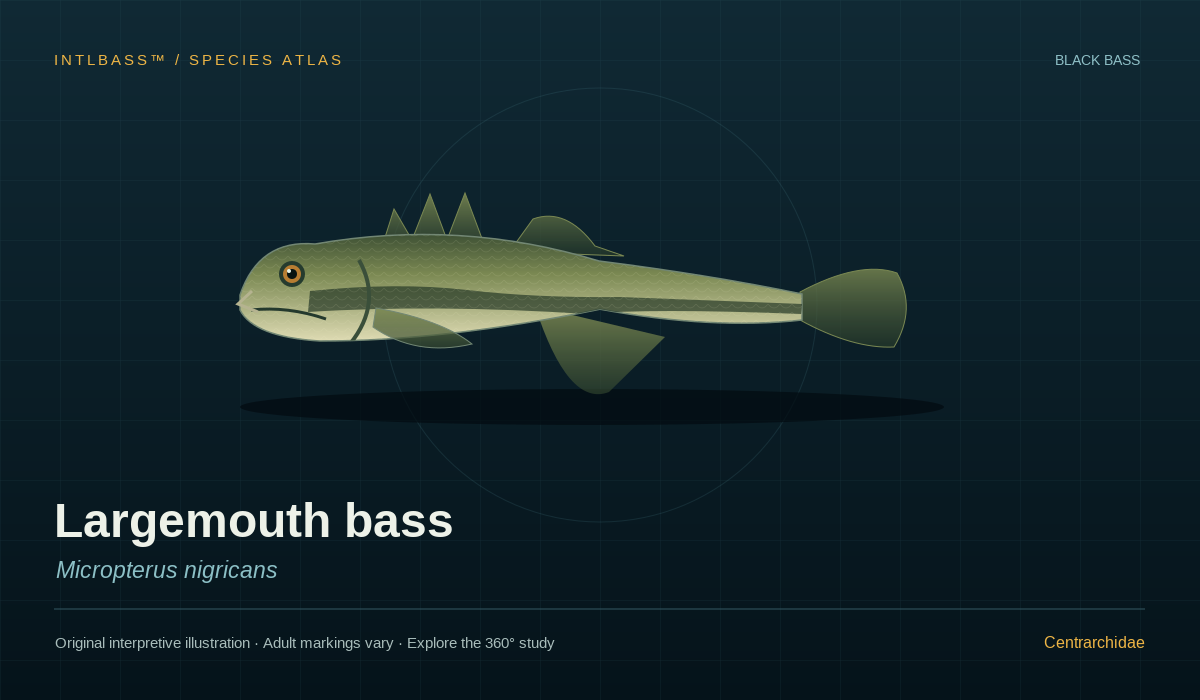 Black bass
Largemouth bass
Micropterus nigricans
The cover-oriented predator behind so much of bass fishing.
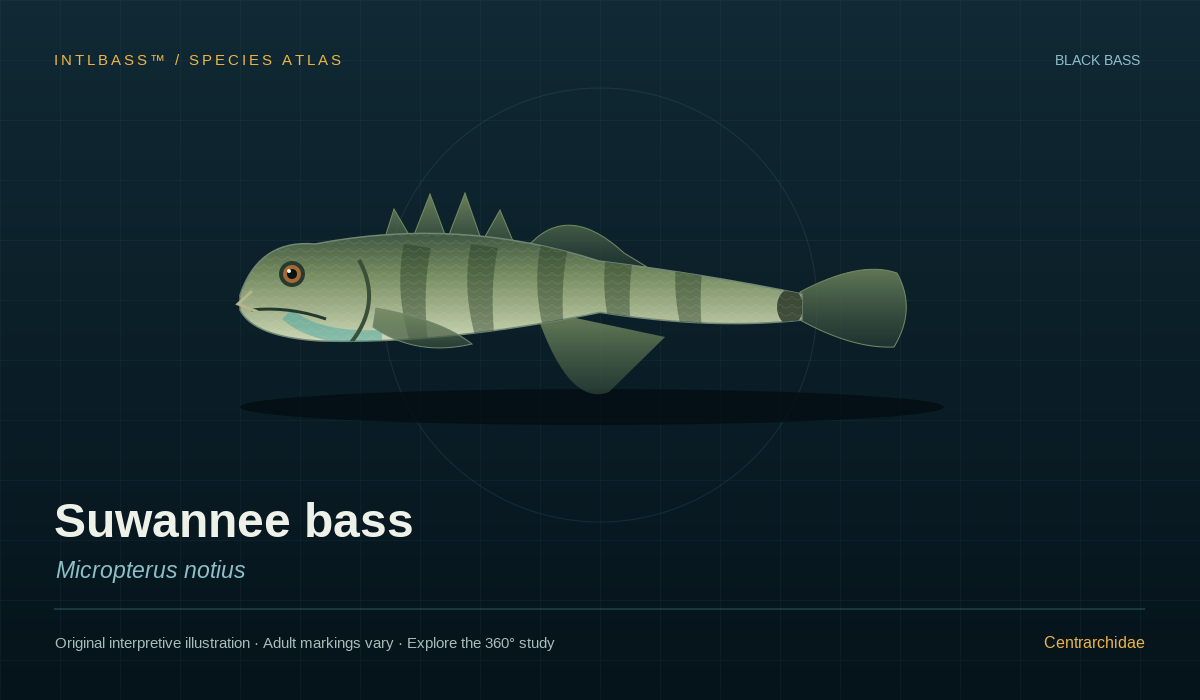 Black bass
Suwannee bass
Micropterus notius
A compact river bass with limestone habitat and turquoise breeding color.
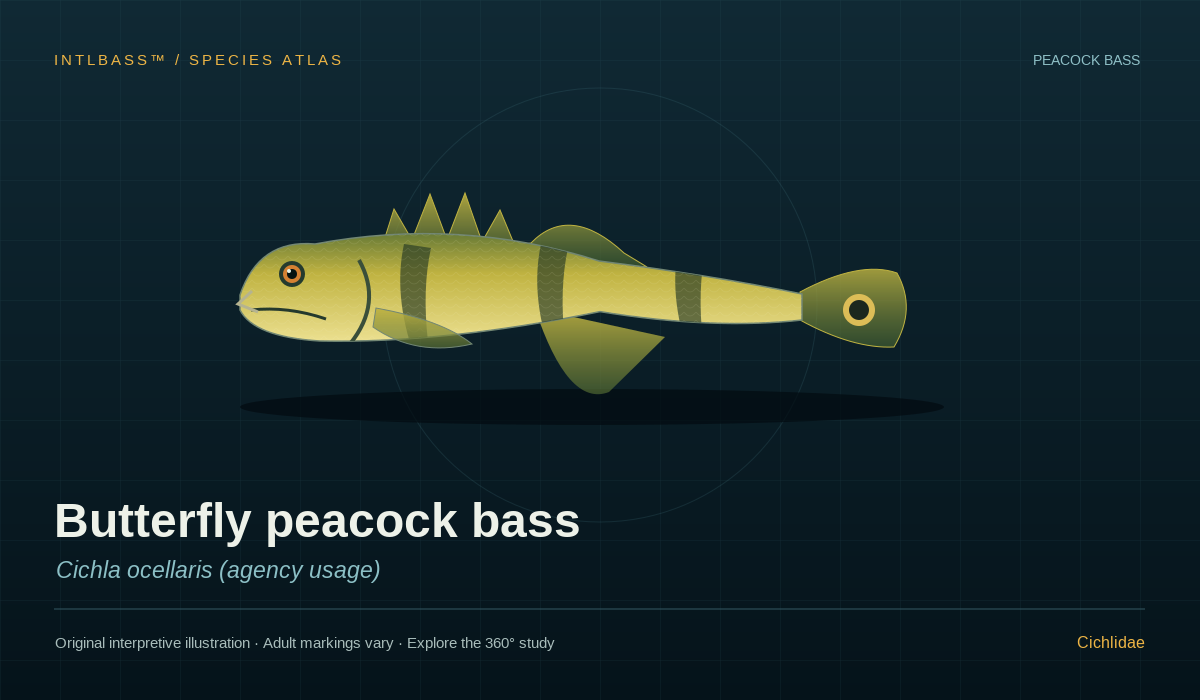 Peacock bass
Butterfly peacock bass
Cichla ocellaris (agency usage)
The colorful Florida canal fish is a cichlid, with a taxonomy caveat.