 International Bass Fishing™
Suwannee Bass: Identification, Habitat & Fishing Guide
BLACK BASS / Centrarchidae · Source review: October 10, 2026
A compact river bass with limestone habitat and turquoise breeding color. This guide distinguishes identification, habitat and distribution evidence, then connects them to practical fishing questions. Explore the original 360° adult-form illustration, map references and the linked fisheries or scientific sources.
INTLBASS™ / 360° FIELD STUDY
Suwannee bass
Micropterus notius · Centrarchidae
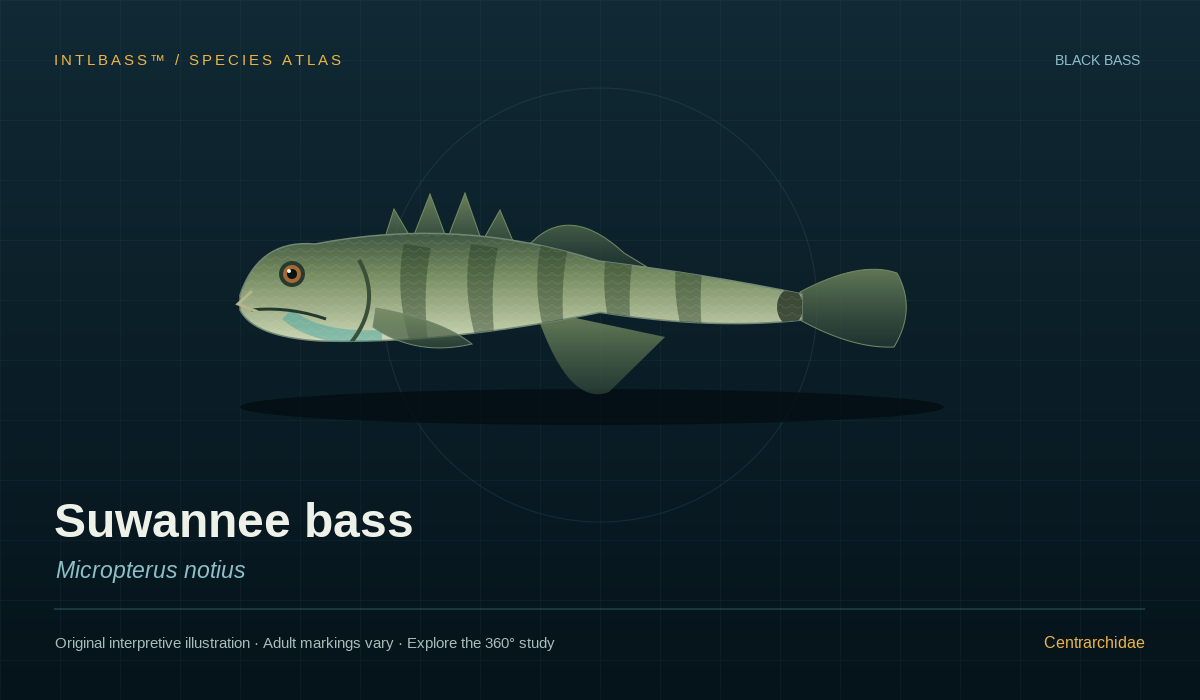
Drag to orbit · Scroll or pinch to zoom · Arrow keys rotate · Shift + arrows move · R resets
Comparison uses equal illustrated body length, not actual adult size.
Loading the interactive illustration…
A river’s name does not identify every bass in it. Combine morphology and watershed context.
Illustration accuracy & sources
Original IntlBass 3D artwork with source-informed silhouette, fin layout and representative adult markings. This is an interpretive illustration, not a specimen scan, measured anatomical reconstruction, genetic test or identification key. Fin-ray counts, teeth, sex, age, regional forms and fine-scale proportions are simplified. Individual colors and markings vary. Largemouth and Florida bass deliberately share closely similar anatomy.
Source review: October 10, 2026. Text and maps below explain identification limits.
At a glance
- Scientific name
- Micropterus notius
- Family / group
- Centrarchidae / Black bass
- Habitat
- Moderate to swift river current around limestone and woody structure.
- Distribution context
- Selected river systems in northern Florida and southern Georgia.
- Food & life stage
- Crayfish are an important food source.
- Reproduction
- FWC reports spawning from February through June.
Identification cues
- Heavy-bodied, usually much smaller than largemouth-type trophy bass.
- Turquoise cheeks, breast and belly can appear in mature fish.
- Shallow dorsal notch, smaller jaw and a distinct tail-base blotch.
A river’s name does not identify every bass in it. Combine morphology and watershed context.
Understand the identity and its limits
Suwannee bass, Micropterus notius, have a limited river-system context in northern Florida and southern Georgia. The name of a river does not identify every bass caught in it. The smaller jaw, body form, dorsal notch and tail-base blotch must be interpreted together. Mature fish can show turquoise coloring around the cheeks, breast and belly; color varies and is not a record-category test.
Connect the biology to the water
FWC’s profile describes current around limestone or woody structure, an important crayfish food source and a February-through-June spawning window. Those are agency-described biology and regional timing, not a promise about today’s bite. Read the linked profile directly for its identification and distribution context. A general bass diagram, a large-fish photograph or a national trophy ranking is a poor substitute for that river-specific evidence.
DISTRIBUTION / SOURCE-LINKED REGIONS
Put the biology on the map.
Approximate reference regions described in the linked sources. Pins are geographic orientation points, not verified fish sightings, fishing spots, launches or complete range boundaries.
FWC-listed river habitat; broad reference pin.
Read the evidence ↗FWC-listed river system. Check local access and rules.
Read the evidence ↗FWC-listed river system, not a fishing ramp.
Read the evidence ↗A practical learning path, from the first cast onward
Start here: Use documented river access and choose a manageable, reachable current break. Confirm conditions with the local manager and avoid assuming that a mapped limestone area is safe to enter. Learn where a presentation travels before attempting to cover a whole river section.
Build the next skill: Compare accessible structure with nearby current edges and record the effort spent on each. Given the crayfish feeding context, ask whether a chosen presentation can work through the intended habitat effectively; this is a planning question, not a claim that one particular product is best.
Advanced practice: Build observations across comparable trips while retaining identification uncertainty. Keep a clear distinction between a personal catch, an agency species description and a certified record. Measurements should state the units and method. Do not infer the fish’s age, sex or genetic identity from an illustrative color patch.
These are editorial practice suggestions informed by the biology above. They are not tested catch-rate comparisons, guarantees, current local regulations or endorsements of a particular product. Read a water-specific fishery guide before applying a general technique.
Conservation, access and useful next steps
Treat a limited-range native fishery with care. Check the current rules and access information for the exact water. Avoid unauthorized fish movement and use the originating fisheries source when comparing distribution claims; our broad region pins cannot establish an individual fish’s origin.
Continue with the shoal bass profile, US guide and location directory. Use the Gear directory to compare equipment categories, and the tournament hub for organizer links and event information.
Use records as evidence, not as a species definition
Open the records and sources section and verify the originating authority’s current listing. Preserve the species name used by that authority, the water, catch date, category, original units and measurement method. An all-tackle weight, a line-class weight, a catch-and-release length and a biological maximum are different claims. Missing information should remain missing; it should not be supplied from a fish photograph or its apparent size.
Primary references for this field study
Illustrations simplify adult shape, markings and external structures. They are not specimen scans or measured reconstructions. Map points are approximate source-described references, not observation records, public fishing spots, depth charts or complete range boundaries. Read the source’s date, taxonomy and geographic scope before reusing its claims.
KEEP EXPLORING
Different fish. Connected stories.
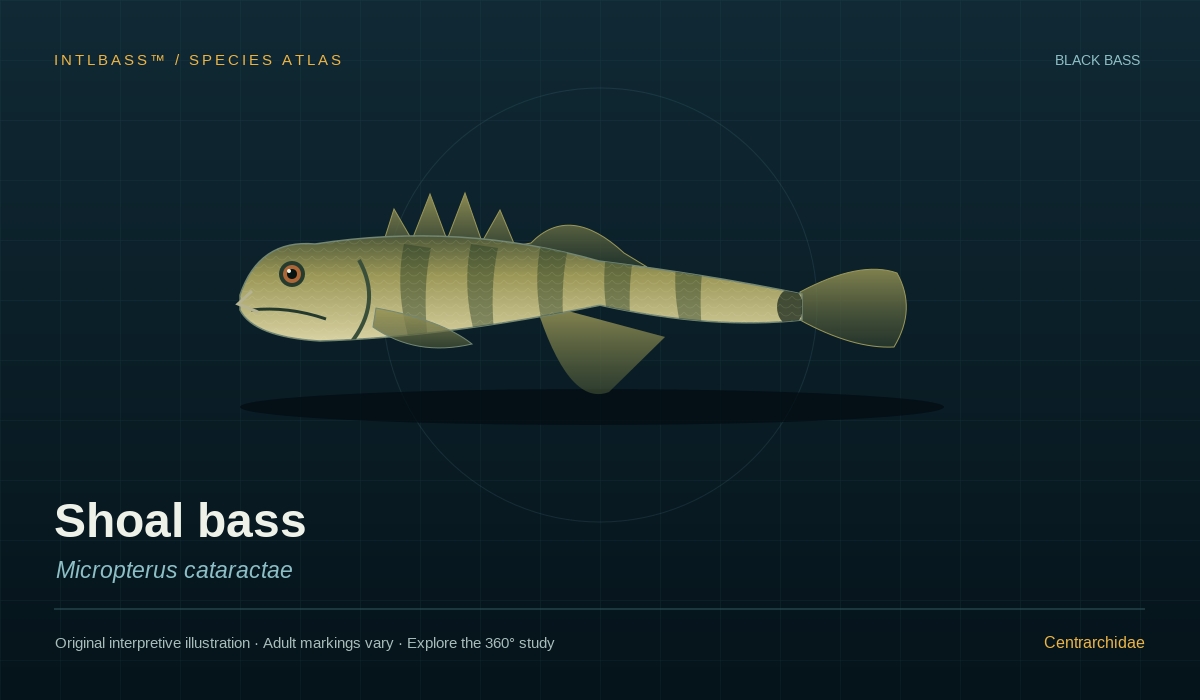 Black bass
Shoal bass
Micropterus cataractae
A river specialist defined by current, rock and drainage history.
 Black bass
Florida bass
Micropterus salmoides
A distinct species, a famous trophy fish, and a naming story worth getting right.
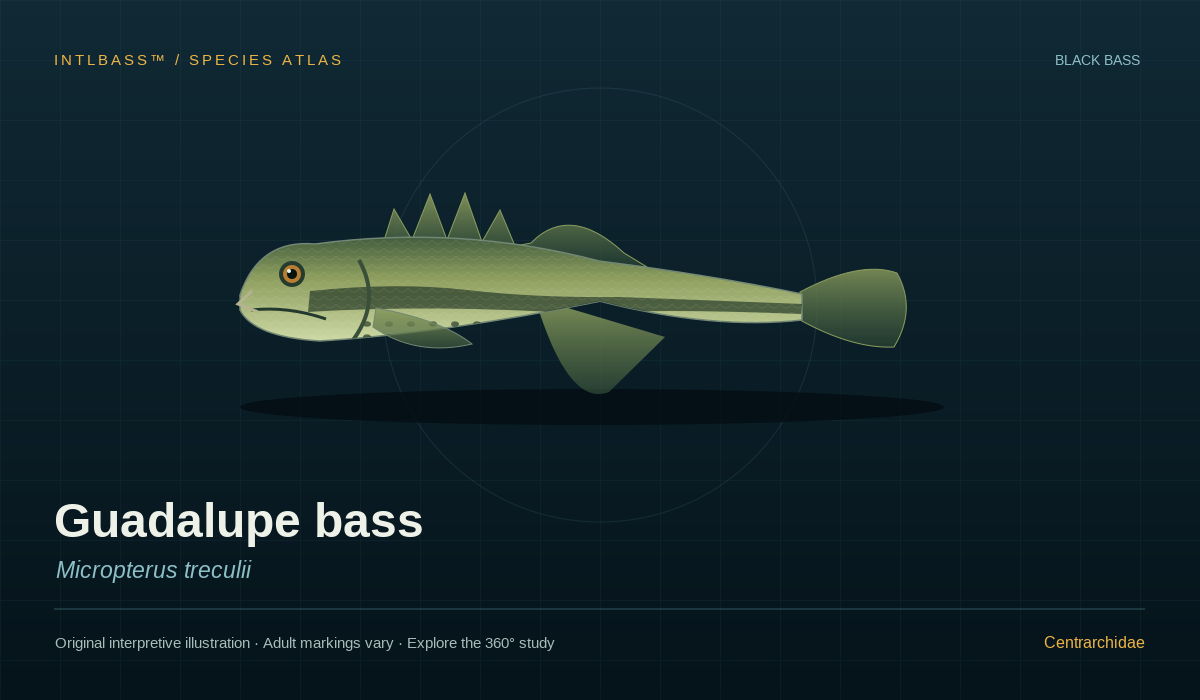 Black bass
Guadalupe bass
Micropterus treculii
Texas’ state fish—and a conservation story written in flowing water.