 International Bass Fishing™
Butterfly Peacock Bass: Identification, Habitat & Fishing Guide
PEACOCK BASS / Cichlidae · Source review: October 10, 2026
The colorful Florida canal fish is a cichlid, with a taxonomy caveat. This guide distinguishes identification, habitat and distribution evidence, then connects them to practical fishing questions. Explore the original 360° adult-form illustration, map references and the linked fisheries or scientific sources.
INTLBASS™ / 360° FIELD STUDY
Butterfly peacock bass
Cichla ocellaris (agency usage) · Cichlidae
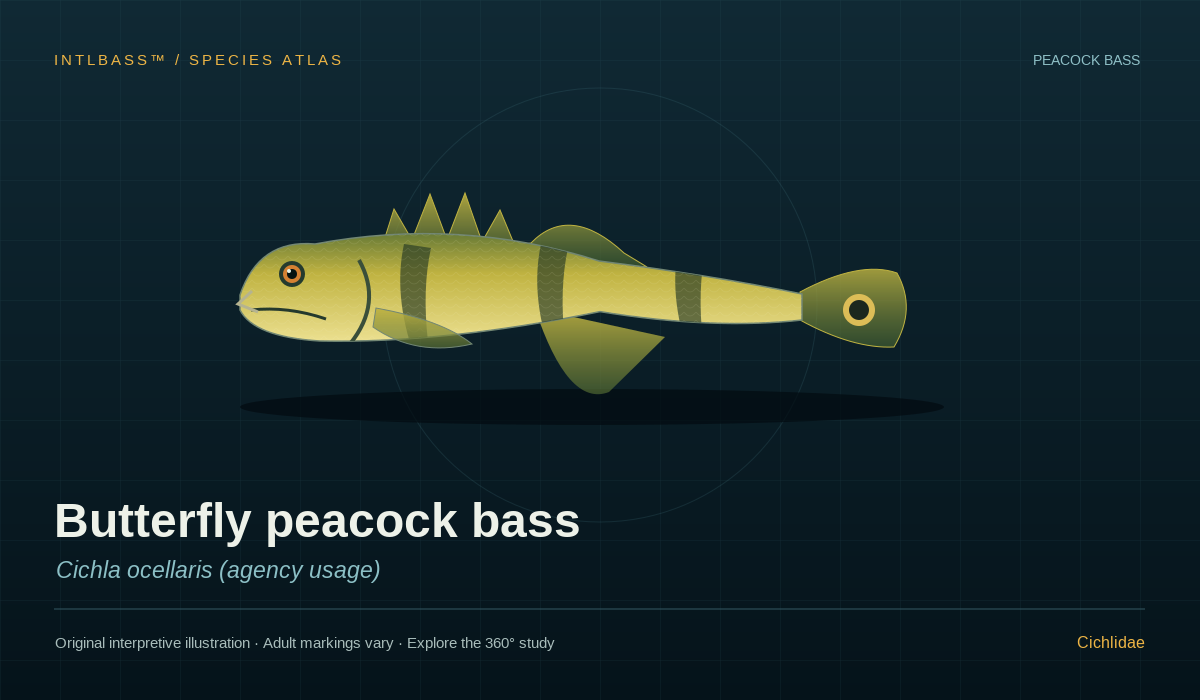
Drag to orbit · Scroll or pinch to zoom · Arrow keys rotate · Shift + arrows move · R resets
Comparison uses equal illustrated body length, not actual adult size.
Loading the interactive illustration…
USGS warns that some fish called C. ocellaris by agencies may be another Cichla species or hybrids.
Illustration accuracy & sources
Original IntlBass 3D artwork with source-informed silhouette, fin layout and representative adult markings. This is an interpretive illustration, not a specimen scan, measured anatomical reconstruction, genetic test or identification key. Fin-ray counts, teeth, sex, age, regional forms and fine-scale proportions are simplified. Individual colors and markings vary. Largemouth and Florida bass deliberately share closely similar anatomy.
Source review: October 10, 2026. Text and maps below explain identification limits.
At a glance
- Scientific name
- Cichla ocellaris (agency usage)
- Family / group
- Cichlidae / Peacock bass
- Habitat
- Warm, slow canals, lakes and ponds; Florida fishery strongly limited by cold.
- Distribution context
- Introduced southeastern Florida fishery; true C. ocellaris has a narrower South American native range.
- Food & life stage
- Primarily fish; an active daytime predator.
- Reproduction
- Substrate spawning with both parents guarding offspring.
Identification cues
- Gold-green body, commonly three dark vertical bars.
- Conspicuous dark tail eyespot with a pale/gold halo.
- Bars may fade with age; breeding males may show a forehead hump.
USGS warns that some fish called C. ocellaris by agencies may be another Cichla species or hybrids.
Understand the identity and its limits
Peacock bass are cichlids in Cichla, not black bass. Florida’s butterfly-peacock fishery is commonly labeled Cichla ocellaris by its agency. USGS cautions that some fish assigned that name by agencies may represent another Cichla species or hybrids. This guide preserves the agency usage and explains the uncertainty; it does not equate all South American peacock bass with the Florida fishery.
Connect the biology to the water
FWC describes the introduced southeastern Florida fishery in warm canals, ponds and lakes. Cold strongly limits the fishery’s geography. The fish are active daytime predators that primarily eat fish, and both parents can guard the substrate-spawned brood. Three dark bars and the conspicuous tail eyespot provide visual context, but bars can fade and breeding form can change.
DISTRIBUTION / SOURCE-LINKED REGIONS
Put the biology on the map.
Approximate reference regions described in the linked sources. Pins are geographic orientation points, not verified fish sightings, fishing spots, launches or complete range boundaries.
FWC-managed regional fishery reference. Pin is not a public bank-access location.
Read the evidence ↗FWC-listed southeastern Florida region; access and cold sensitivity matter.
Read the evidence ↗USGS distinguishes the true C. ocellaris native range from broad agency naming. This is a regional marker.
Read the evidence ↗A practical learning path, from the first cast onward
Start here: For a Florida trip, use the agency’s fishery information and documented public access for a particular canal or lake. A canal visible on Google Maps may cross private land or restricted infrastructure. Learn a controlled presentation that follows the accessible water rather than treating a regional occurrence pin as a public fishing spot.
Build the next skill: Keep local habitat, presentation and effort in the log. The daytime feeding context is useful when choosing what to investigate, but it is not a universal catch forecast. Observe which accessible structures and water conditions accompany activity instead of relying solely on a lure’s marketing name.
Advanced practice: Distinguish the Florida agency name, a South American scientific identification and an informal “peacock” record. A large fish or a body-color variant does not establish the species. Read the original record category and source before comparing a Florida catch with an Amazon or Orinoco catch.
These are editorial practice suggestions informed by the biology above. They are not tested catch-rate comparisons, guarantees, current local regulations or endorsements of a particular product. Read a water-specific fishery guide before applying a general technique.
Conservation, access and useful next steps
Follow current local rules and property boundaries. Do not move fish between canal systems or countries. Our model illustrates a representative adult form with simplified anatomy; it cannot resolve the taxonomic uncertainty discussed by USGS.
Continue with the US guide, speckled peacock study and location directory. Use the Gear directory to compare equipment categories, and the tournament hub for organizer links and event information.
Use records as evidence, not as a species definition
Open the records and sources section and verify the originating authority’s current listing. Preserve the species name used by that authority, the water, catch date, category, original units and measurement method. An all-tackle weight, a line-class weight, a catch-and-release length and a biological maximum are different claims. Missing information should remain missing; it should not be supplied from a fish photograph or its apparent size.
Primary references for this field study
- FWC · Butterfly peacock fishery and biology ↗
- USGS · Butterfly peacock taxonomy caveat and records ↗
Illustrations simplify adult shape, markings and external structures. They are not specimen scans or measured reconstructions. Map points are approximate source-described references, not observation records, public fishing spots, depth charts or complete range boundaries. Read the source’s date, taxonomy and geographic scope before reusing its claims.
KEEP EXPLORING
Different fish. Connected stories.
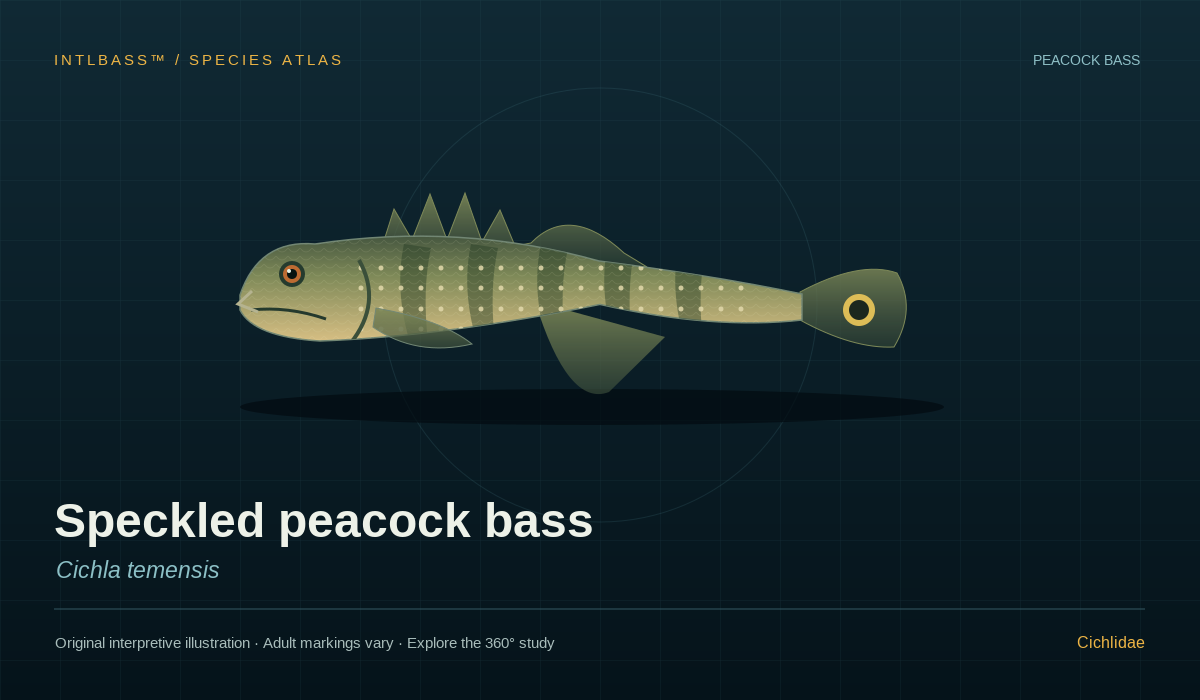 Peacock bass
Speckled peacock bass
Cichla temensis
Speckled and barred forms can be the same species at different reproductive stages.
 Black bass
Florida bass
Micropterus salmoides
A distinct species, a famous trophy fish, and a naming story worth getting right.
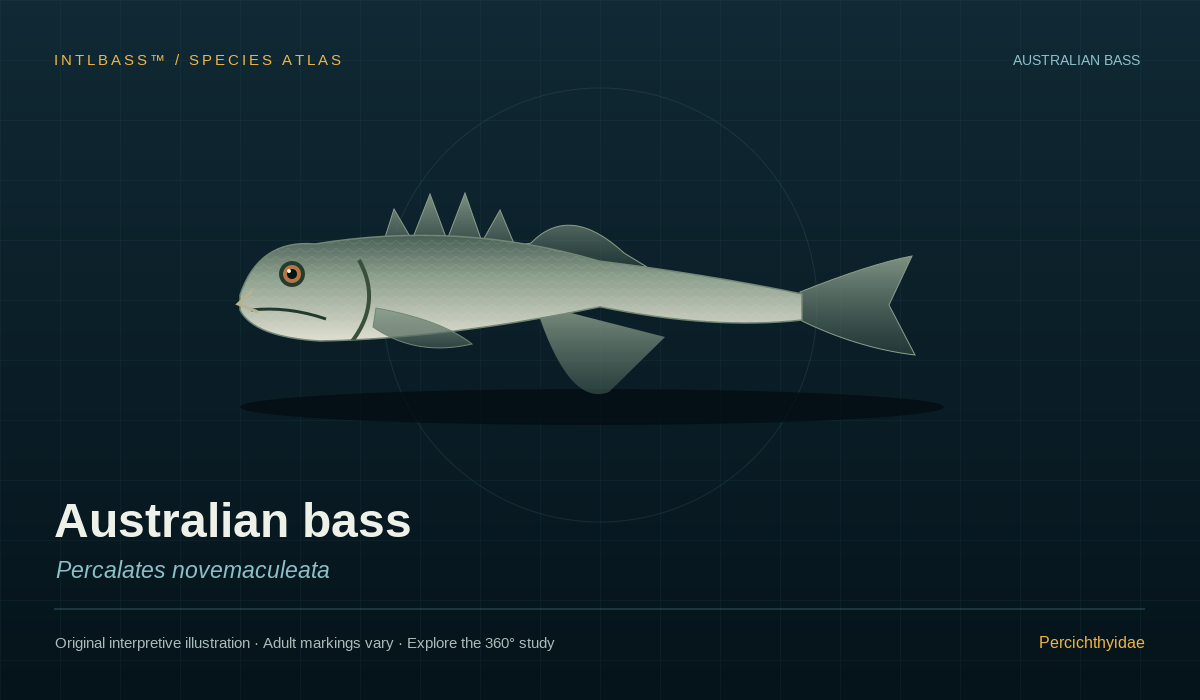 Australian bass
Percalates novemaculeata
Freshwater resident, estuary spawner, and an eastern Australian original.