 International Bass Fishing™
Australian Bass: Identification, Habitat & Fishing Guide
AUSTRALIAN BASS / Percichthyidae · Source review: October 10, 2026
Freshwater resident, estuary spawner, and an eastern Australian original. This guide distinguishes identification, habitat and distribution evidence, then connects them to practical fishing questions. Explore the original 360° adult-form illustration, map references and the linked fisheries or scientific sources.
INTLBASS™ / 360° FIELD STUDY
Australian bass
Percalates novemaculeata · Percichthyidae
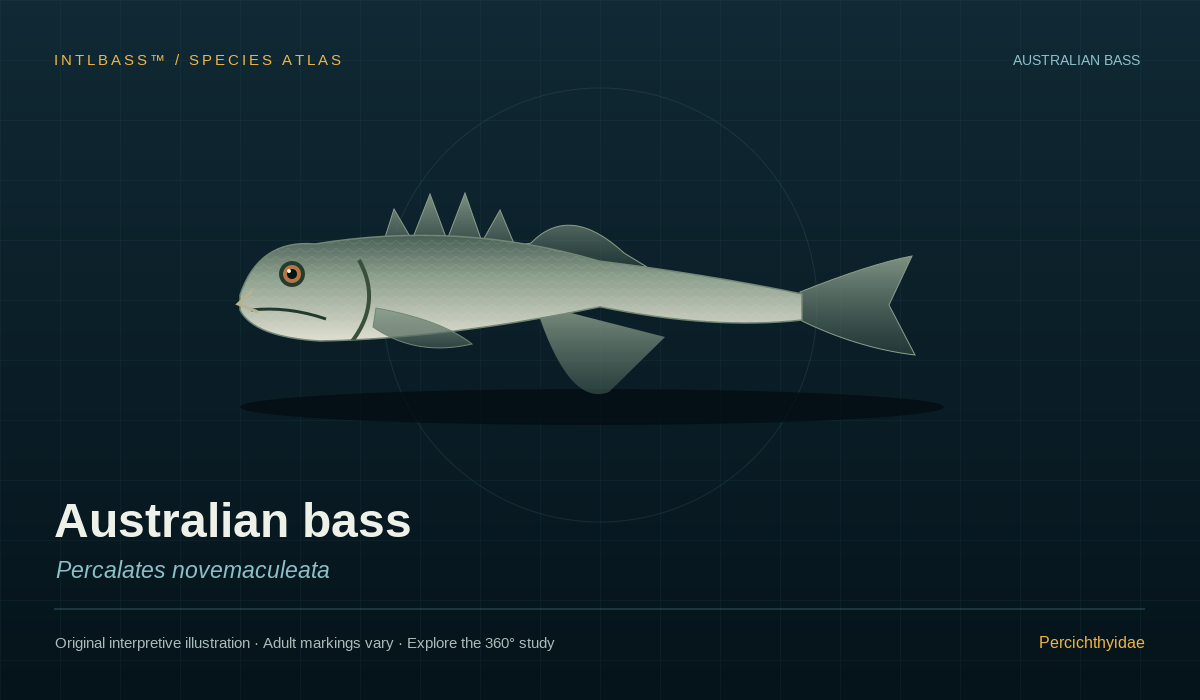
Drag to orbit · Scroll or pinch to zoom · Arrow keys rotate · Shift + arrows move · R resets
Comparison uses equal illustrated body length, not actual adult size.
Loading the interactive illustration…
Estuary perch are a distinct close relative and can hybridize. Older sources use Macquaria novemaculeata.
Illustration accuracy & sources
Original IntlBass 3D artwork with source-informed silhouette, fin layout and representative adult markings. This is an interpretive illustration, not a specimen scan, measured anatomical reconstruction, genetic test or identification key. Fin-ray counts, teeth, sex, age, regional forms and fine-scale proportions are simplified. Individual colors and markings vary. Largemouth and Florida bass deliberately share closely similar anatomy.
- Museums Victoria / Fishes of Australia · Australian bass ↗
- NSW DPIRD · Australian bass ↗
- NSW DPIRD · Habitat factsheets ↗
Source review: October 10, 2026. Text and maps below explain identification limits.
At a glance
- Scientific name
- Percalates novemaculeata
- Family / group
- Percichthyidae / Australian bass
- Habitat
- Eastern coastal rivers, lakes, impoundments and brackish estuaries.
- Distribution context
- Endemic to southeastern Australian coastal drainages; translocations and stockings also occur.
- Food & life stage
- Adults eat fish, crustaceans and insects; juveniles begin with zooplankton.
- Reproduction
- Catadromous: adults migrate downstream to estuaries to reproduce.
Identification cues
- Grey-green sides with a paler belly and a relatively large eye.
- Moderately notched dorsal fin and slightly forked tail.
- Adult color is subtler than juvenile fin blotches.
Estuary perch are a distinct close relative and can hybridize. Older sources use Macquaria novemaculeata.
Understand the identity and its limits
Australian bass, Percalates novemaculeata, belong to Percichthyidae rather than the American black-bass genus. Older sources use Macquaria novemaculeata. Estuary perch are a distinct close relative, and hybridization adds identification limits. The adult illustration uses subdued gray-green coloring; juvenile blotches, age and viewing conditions should not be treated as universal adult markings.
Connect the biology to the water
The native reference is southeastern Australia’s coastal drainages. Rivers, impoundments and brackish estuaries have different connectivity and management contexts. Australian bass are catadromous: adults move downstream to estuaries to reproduce. Freshwater residency therefore describes only part of the life cycle. The Fishes of Australia and NSW fisheries sources distinguish biology from stocking and translocation; do not infer natural reproduction in every impoundment.
DISTRIBUTION / SOURCE-LINKED REGIONS
Put the biology on the map.
Approximate reference regions described in the linked sources. Pins are geographic orientation points, not verified fish sightings, fishing spots, launches or complete range boundaries.
Northern coastal reference from the museum and NSW accounts.
Read the evidence ↗Broad regional orientation, not a specific stocking or access site.
Read the evidence ↗Southern coastal reference; exact range endpoints vary between agency summaries.
Read the evidence ↗A practical learning path, from the first cast onward
Start here: Choose the exact river or impoundment and read the relevant state’s current fishing rules and access information. Understand whether the water has an estuarine connection or a stocked fishery. Start with accessible habitat and a presentation that you can control reliably from your chosen platform.
Build the next skill: Record structure, current, water clarity and presentation path in a local log. Compare similar reaches rather than applying a northern-hemisphere black-bass calendar. The spawning migration provides a biological reason to examine connectivity and season, but does not establish a present closure or an automatic fishing pattern.
Advanced practice: Keep natural distribution, stocking history and record categories separate. A biological size maximum is not a certified catch record. Scientific standard length and an angler’s total length are different measurements; preserve the source’s method instead of converting between them without supporting evidence.
These are editorial practice suggestions informed by the biology above. They are not tested catch-rate comparisons, guarantees, current local regulations or endorsements of a particular product. Read a water-specific fishery guide before applying a general technique.
Conservation, access and useful next steps
Follow the current state rules for the exact water and season. Do not copy historical closures into a current trip plan. Fish movement and habitat connectivity are management matters, not permissions supplied by a species map or an online occurrence record.
Continue with the Australia guide, record-source directory and equipment resources. Use the Gear directory to compare equipment categories, and the tournament hub for organizer links and event information.
Use records as evidence, not as a species definition
Open the records and sources section and verify the originating authority’s current listing. Preserve the species name used by that authority, the water, catch date, category, original units and measurement method. An all-tackle weight, a line-class weight, a catch-and-release length and a biological maximum are different claims. Missing information should remain missing; it should not be supplied from a fish photograph or its apparent size.
Primary references for this field study
- Museums Victoria / Fishes of Australia · Australian bass ↗
- NSW DPIRD · Australian bass ↗
- NSW DPIRD · Habitat factsheets ↗
Illustrations simplify adult shape, markings and external structures. They are not specimen scans or measured reconstructions. Map points are approximate source-described references, not observation records, public fishing spots, depth charts or complete range boundaries. Read the source’s date, taxonomy and geographic scope before reusing its claims.
KEEP EXPLORING
Different fish. Connected stories.
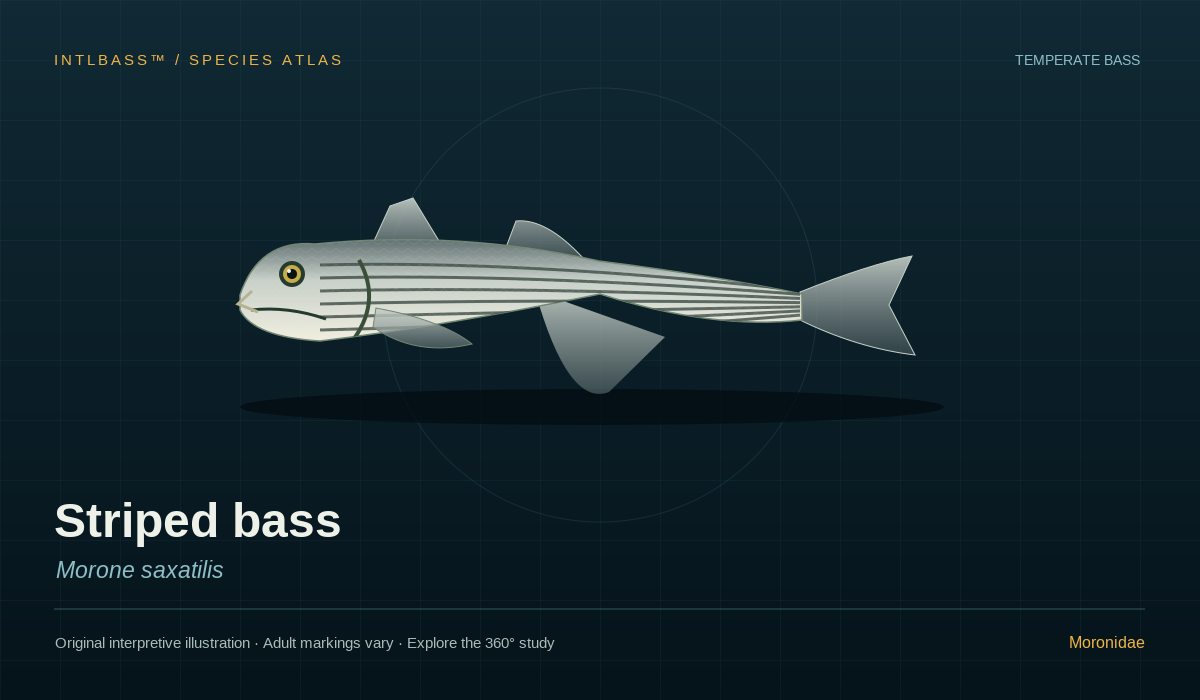 Temperate bass
Striped bass
Morone saxatilis
An Atlantic migrator with a separate inland-fishery story.
 Black bass
Smallmouth bass
Micropterus dolomieu
Bronze flanks, rocky water and a different habitat story.
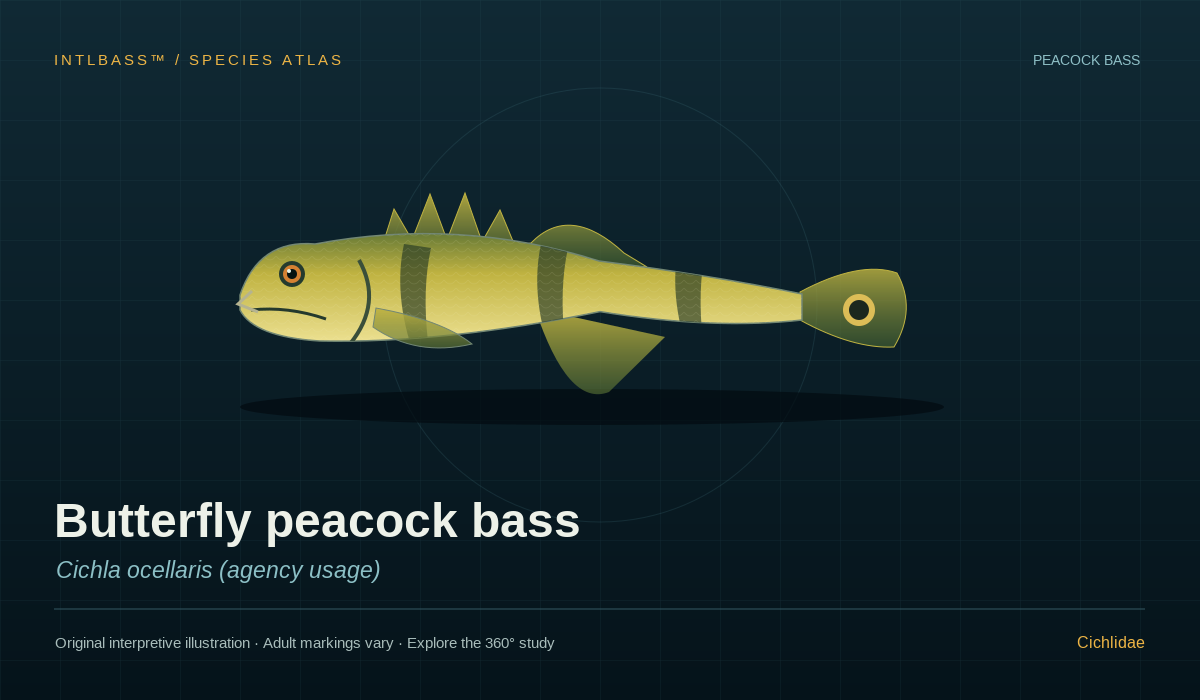 Peacock bass
Butterfly peacock bass
Cichla ocellaris (agency usage)
The colorful Florida canal fish is a cichlid, with a taxonomy caveat.