 International Bass Fishing™
Smallmouth Bass: Identification, Habitat & Fishing Guide
BLACK BASS / Centrarchidae · Source review: October 10, 2026
Bronze flanks, rocky water and a different habitat story. This guide distinguishes identification, habitat and distribution evidence, then connects them to practical fishing questions. Explore the original 360° adult-form illustration, map references and the linked fisheries or scientific sources.
INTLBASS™ / 360° FIELD STUDY
Smallmouth bass
Micropterus dolomieu · Centrarchidae

Drag to orbit · Scroll or pinch to zoom · Arrow keys rotate · Shift + arrows move · R resets
Comparison uses equal illustrated body length, not actual adult size.
Loading the interactive illustration…
Texas populations include stockings outside the species’ native range. A catch record is not a native-range record.
Illustration accuracy & sources
Original IntlBass 3D artwork with source-informed silhouette, fin layout and representative adult markings. This is an interpretive illustration, not a specimen scan, measured anatomical reconstruction, genetic test or identification key. Fin-ray counts, teeth, sex, age, regional forms and fine-scale proportions are simplified. Individual colors and markings vary. Largemouth and Florida bass deliberately share closely similar anatomy.
Source review: October 10, 2026. Text and maps below explain identification limits.
At a glance
- Scientific name
- Micropterus dolomieu
- Family / group
- Centrarchidae / Black bass
- Habitat
- Clear lakes and cool, rocky or gravel-bottomed streams.
- Distribution context
- Native to central and eastern North America; introductions extend the modern range.
- Food & life stage
- Juveniles progress from tiny invertebrates to insects, fish and crayfish.
- Reproduction
- Spring nest spawning; males guard eggs and young.
Identification cues
- Upper jaw does not reach behind the eye.
- Bronze or brown-green sides, commonly with vertical bars.
- Body color varies; combine shape, markings and drainage.
Texas populations include stockings outside the species’ native range. A catch record is not a native-range record.
Understand the identity and its limits
Smallmouth are black bass, not a small version of largemouth bass. The shorter jaw, bronze-to-brown-green body and commonly barred flanks provide useful cues when read together. A fish’s color alone is an unreliable identifier. Use an agency identification guide with a clear side view and the watershed context, especially where multiple black bass or hybrids occur.
Connect the biology to the water
Clear lakes and rocky or gravel-bottomed streams are the habitat context described in TPWD’s account. Diet changes through life: tiny invertebrates give way to larger insects, crayfish and fish. Males guard nests and young. Central and eastern North American native distribution is distinct from modern stocking and introduction records; a Texas smallmouth fishery does not by itself establish native status.
DISTRIBUTION / SOURCE-LINKED REGIONS
Put the biology on the map.
Approximate reference regions described in the linked sources. Pins are geographic orientation points, not verified fish sightings, fishing spots, launches or complete range boundaries.
Broad northern region in the TPWD native-range account.
Read the evidence ↗Southern native-range reference, not a launch location.
Read the evidence ↗TPWD describes stockings in Texas, including Edwards Plateau streams; check individual waters.
Read the evidence ↗A practical learning path, from the first cast onward
Start here: Begin with a documented shore or boat-access area and a piece of fishable rocky habitat. Choose a lure you can keep in contact with the intended water without repeatedly hanging it in the bottom. Learn how current or wind changes the retrieve and keep the first session’s target area small enough to understand.
Build the next skill: Compare current breaks, different bottom textures and adjacent depth changes using the best local information available. Change one presentation variable at a time. Record where the lure traveled and what conditions accompanied a catch, rather than writing only the name of a successful lure.
Advanced practice: Evaluate a pattern across comparable habitat and effort. Keep native-range evidence separate from stocking records and personal catches. If you compare fish lengths, use the same measurement method and record the original units; a photographed ruler without its method is a weak basis for a record claim.
These are editorial practice suggestions informed by the biology above. They are not tested catch-rate comparisons, guarantees, current local regulations or endorsements of a particular product. Read a water-specific fishery guide before applying a general technique.
Conservation, access and useful next steps
Check current regulations for the exact water and season. Nest-guarding behavior is a biological fact, not a general invitation to target nests. Local managers may have restrictions or conservation priorities that a broad species page cannot resolve.
Continue with the Canada guide, United States guide and location directory. Use the Gear directory to compare equipment categories, and the tournament hub for organizer links and event information.
Use records as evidence, not as a species definition
Open the records and sources section and verify the originating authority’s current listing. Preserve the species name used by that authority, the water, catch date, category, original units and measurement method. An all-tackle weight, a line-class weight, a catch-and-release length and a biological maximum are different claims. Missing information should remain missing; it should not be supplied from a fish photograph or its apparent size.
Primary references for this field study
Illustrations simplify adult shape, markings and external structures. They are not specimen scans or measured reconstructions. Map points are approximate source-described references, not observation records, public fishing spots, depth charts or complete range boundaries. Read the source’s date, taxonomy and geographic scope before reusing its claims.
KEEP EXPLORING
Different fish. Connected stories.
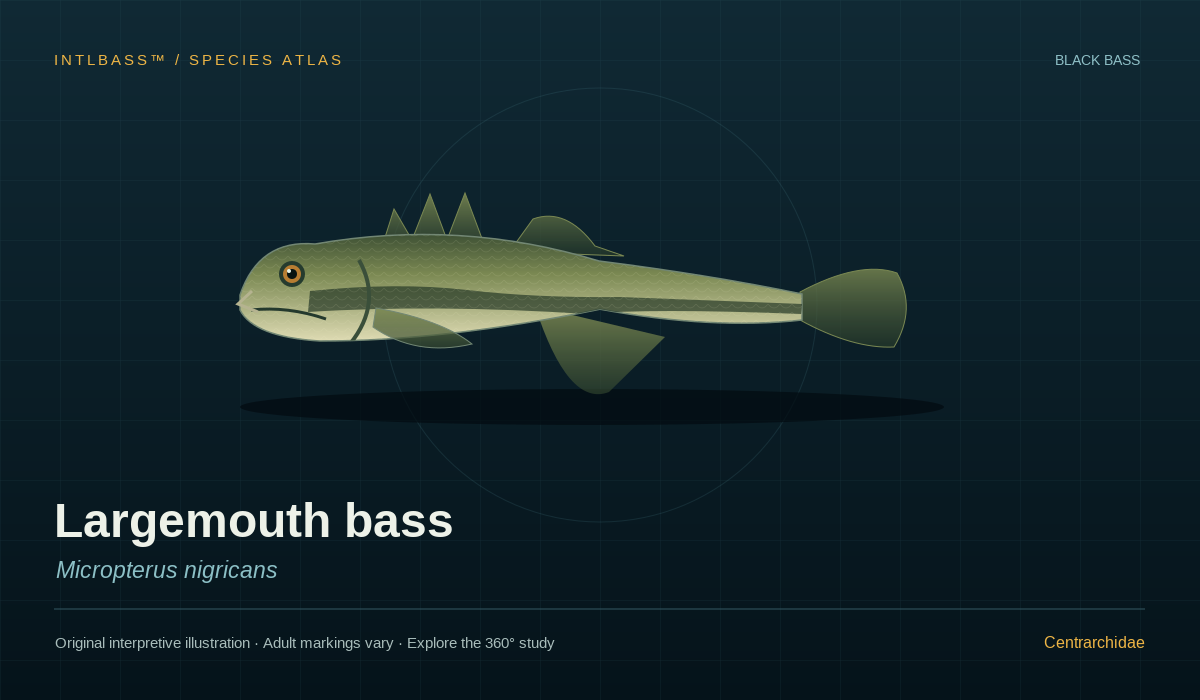 Black bass
Largemouth bass
Micropterus nigricans
The cover-oriented predator behind so much of bass fishing.
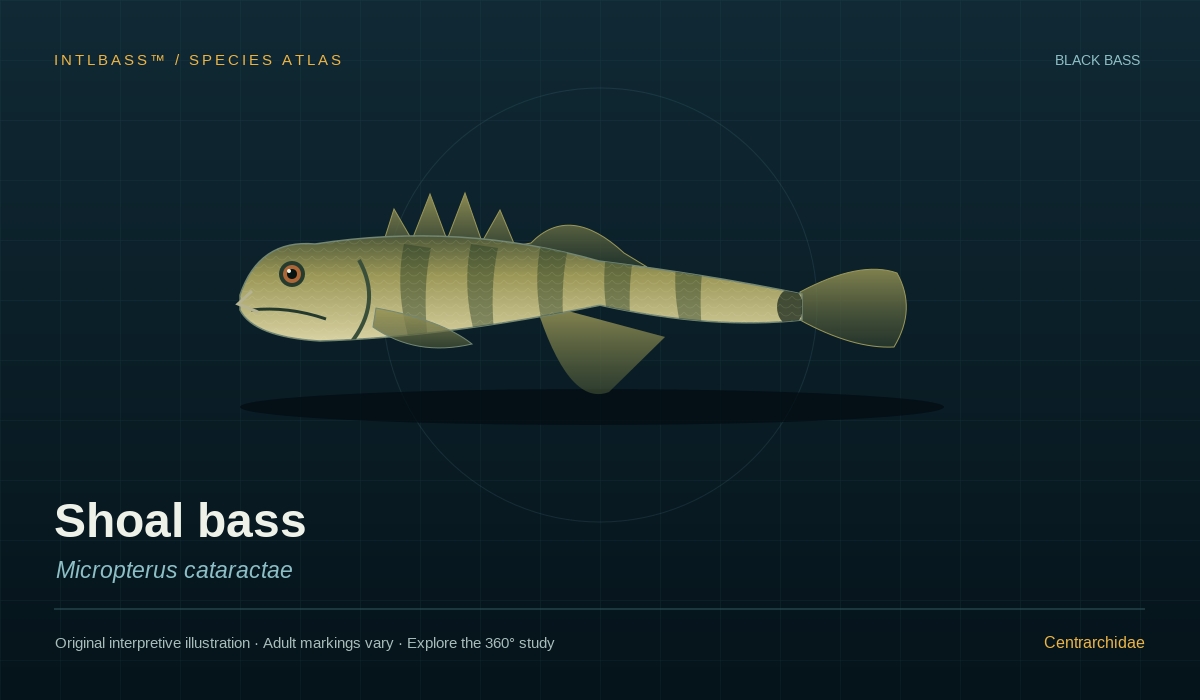 Black bass
Shoal bass
Micropterus cataractae
A river specialist defined by current, rock and drainage history.
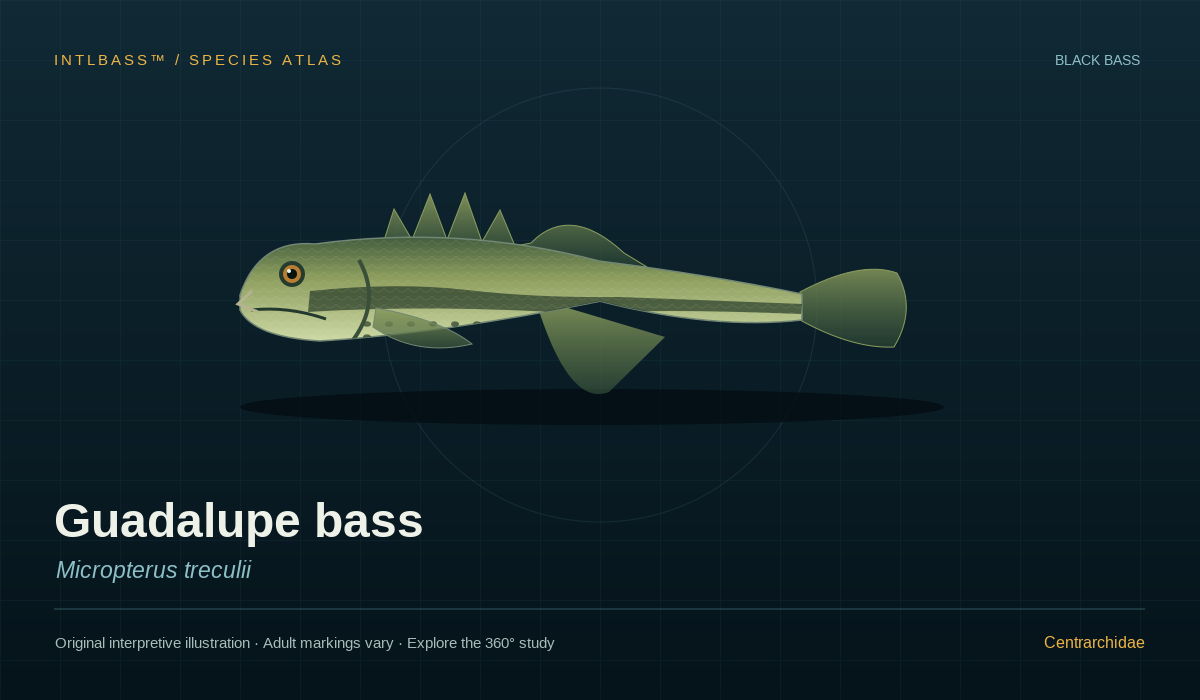 Black bass
Guadalupe bass
Micropterus treculii
Texas’ state fish—and a conservation story written in flowing water.