 International Bass Fishing™
THE DEPTH CHART / TECHNIQUE
Hold it still where they live.
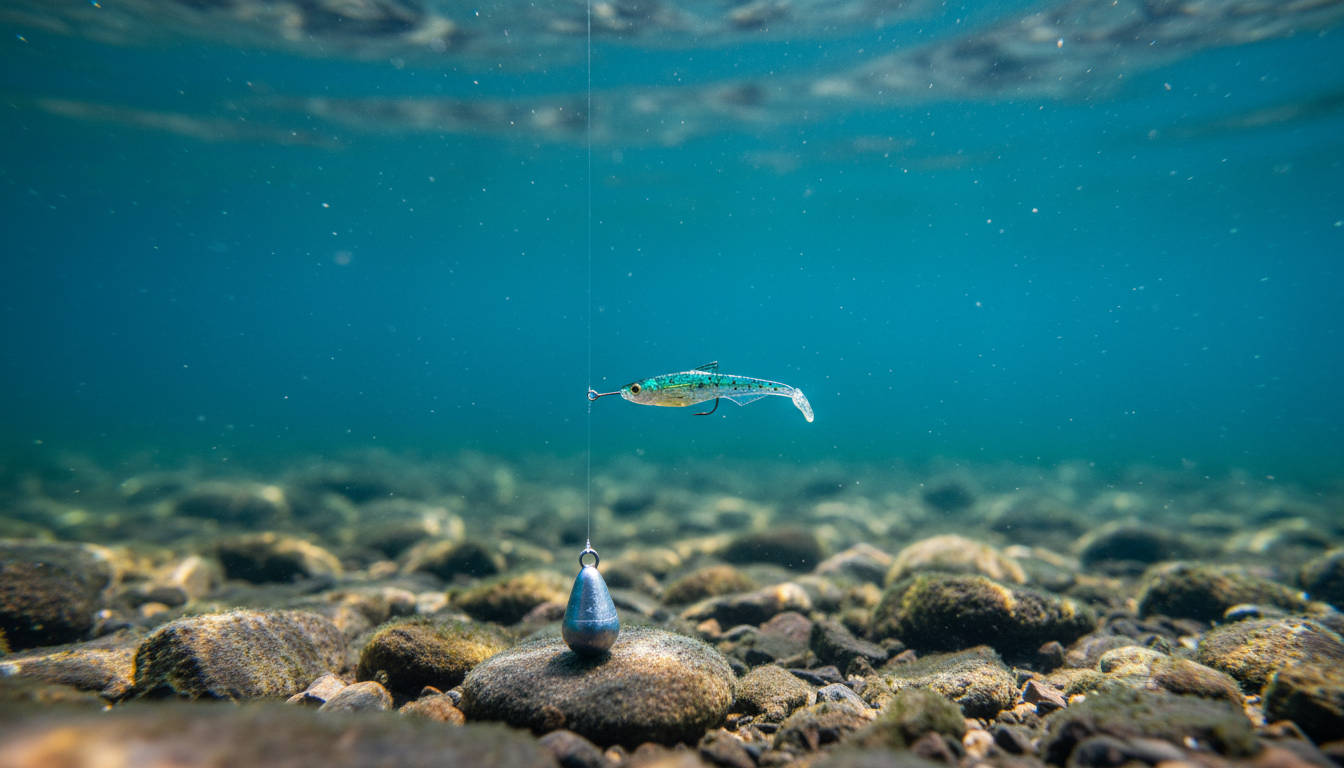
A drop shot hangs a small bait above a sinker so it can quiver in one spot at a set height off the bottom. Get three numbers right — tag length, weight and hook size — and it becomes the rig you reach for when bass get tough.
The drop shot flips the usual rig upside down. Instead of a sinker sitting on the hook, the hook is tied partway up the line and the sinker hangs below it on the tag end. The weight holds bottom; the bait floats above it, held at whatever height you choose, and it can shimmy in place for as long as you have patience. As Bassmaster’s Kotaro Kiriyama piece puts it in so many words, the rig gives the bait action without having to move it forward.
This guide pulls together published setups from Bassmaster, Wired2Fish, In-Fisherman, Tackle Warehouse, FishUSA and two early accounts of the rig, then shows how to adjust them. Every number is a starting point. If you are still sorting out basic tackle, start with our beginner’s guide.

Background
What the drop shot is — and where it came from
Early American accounts credit Japanese anglers with the rig, though none documents a single inventor or date. A 2000 BassResource article by Greg Hines, reprinted from Bass West, says it was developed in Japan and that its Japanese name translates as “always lucky.” Spencer Petros, writing for boats.com in 2001, describes Japanese anglers developing it for clear, crowded waters, where he reports a weekend tournament on a small lake could draw 700 to 800 anglers. And Kiriyama told Bassmaster in 2011 that it reached the U.S. West Coast from Japan roughly 15 years earlier, after being developed on heavily fished lakes there. Treat the origin as these anglers’ accounts rather than settled history.
That origin explains what it is good at: tempting fish that have seen everything. In-Fisherman calls it effective from coast to coast and especially good for smallmouth, and Bassmaster’s top-lures reports list drop shots among the top finishers’ baits at waters as different as Lake Lanier, Mille Lacs, Lake St. Clair and the St. Lawrence River. It works for largemouth and spotted bass too — see our species atlas for where each lives.

How-to
Rig it in four steps
- Tie on the hook with a long tag. A Palomar is the usual knot. Leave a tag end longer than the distance you want between hook and sinker.
- Make the hook stand out. Pass the tag end back through the hook eye so the hook stands out from the line with the point facing up. Both Kiriyama and Hines describe this step.
- Clip or tie on the weight. Attach a drop-shot sinker to the end of the tag, then trim the tag to the length you want.
- Add the bait. Nose-hook it through the tip of the head for open water, or Texas-rig it on a worm hook when you are fishing around cover.
Wired2Fish treats nose-hooking as the default and reserves Texas-rigging for cover. Hines described carrying both: a 1/0 worm hook Texas-rigged for weedless work and a smaller No. 2 hook for nose-hooking. Wired2Fish says baits under about six inches, without a lot of legs and arms, are the ones that draw bites.
Tackle Warehouse describes both clip-on and tie-on drop-shot weights; clip-on styles make it quicker to change weight or tag length. Petros notes that Bakudan-style weights attach without a knot and pull free when snagged, so you lose only the weight. Carry spares.
The key number
Tag length: set the bait at their level
The distance between the hook and the sinker — anglers call it the tag or leader — decides how high the bait rides. Published guidance clusters around a foot to a foot and a half, but it ranges widely because the right answer depends on where the fish are holding.
Tag length: how far the hook rides above the sinker
Inches between hook and weight, as published
Hines reported that an 18- to 20-inch separation out-fished shorter rigs on Arizona’s Lake Pleasant and recommended carrying one short and one long rig. Pro angler Jacob Powroznik told Wired2Fish he runs a 16- to 18-inch tag in sun and shortens it to 6 to 8 inches when it’s cloudy. Cast & Spear suggests going as short as 6 to 10 inches for fish glued to the bottom and as long as three or four feet when they suspend higher.
The practical approach: start around 12 to 18 inches, then adjust. If your electronics show fish a couple of feet off the bottom, lengthen the tag until the bait sits at their level. If bites come only as the bait touches down, shorten it.
Weight
Choosing a sinker weight
Weight controls how fast you get down, how well you feel the bottom and how much the wind pushes you around. Wired2Fish suggests starting at 1/8 or 1/4 ounce; its author has used anything from 1/16 up to 1/2 ounce, picking the lightest weight that still lets him feel bottom. Petros and Cast & Spear both put most situations at 1/8 to 3/8 ounce. Powroznik likes 3/8 and 1/2 ounce but dropped to 1/4 ounce on Lake St. Clair, where he says the water is no more than about 20 feet deep.
Drop-shot weights in the 2023 St. Clair Elite top 10
Sinker weight each angler reported, in sixteenths of an ounce
That St. Clair Elite is a useful real-world snapshot: eight of the top ten featured a drop shot, and every drop-shot weight they reported fell between 1/4 and 1/2 ounce on a lake that averages about 11 feet. Several specified tungsten, which packs the same weight into a smaller sinker — the same trade-off we explain in our Texas rig guide.
A 2020 Connecticut legislative research report lists five states — Maine, Massachusetts, New Hampshire, New York and Vermont — that restrict some lead sinkers or jigs for freshwater fishing, with different size limits in each, and rules have kept changing since (Maine added painted lead jigs to its use ban on September 1, 2026). Our Texas rig guide summarises current state rules. The EPA lists fishing among hobbies that can expose people to lead. Check your state’s current rules, keep lead away from kids, and wash your hands after handling it.
Tackle
Hooks, line and rod
Drop-shot hooks are small and light. Wired2Fish puts the usual range at No. 1 to 1/0 and recommends a light-wire hook set by reeling into the fish rather than a big sweep. Gamakatsu’s Split Shot/Drop Shot hook, a common example, comes in sizes from No. 4 up to 3/0. Remember that plain-numbered sizes get smaller as the number gets larger, so a No. 2 is smaller than a No. 1, which is smaller than a 1/0.
| Bait length | Common starting hook | Source |
|---|---|---|
| 2–3 inches | No. 2 or No. 1 | FishUSA drop-shot hook guide |
| 3–4 inches | No. 1 or 1/0 | FishUSA drop-shot hook guide |
| 3–5 inch finesse worm | No. 2 or No. 1 | FishUSA hook-size guide |
| 4–5 inches | 2/0 for more gap | FishUSA drop-shot hook guide |
| 5–7 inches | 1/0 | FishUSA hook-size guide |
Sources: FishUSA, “Best Drop Shot Hooks for Bass” and “Hook Size for Bass.” The two FishUSA pages overlap slightly; size down when in doubt.
Line is light. Wired2Fish suggests 6- or 8-pound fluorocarbon, often run as a 4- to 6-foot leader on 15- or 20-pound braid. Kiriyama used 6- to 10-pound fluorocarbon; Powroznik prefers 6-pound and suggests loosening the drag slightly. Rods are spinning sticks: around seven feet in medium-light power is Wired2Fish’s standard, with 6½ feet for vertical work. For more on line choice, see our fishing line guide.
Working the bait
Less is more. Petros suggests quivering the rod tip three or four times after the weight touches down, then dropping the rod back 6 to 12 inches to give slack so a fish can take the bait. FishUSA’s retrieve guide advises thinking in centimetres rather than feet. Kiriyama describes his hookset as somewhere between a jerk and a sweep; with light wire and light line, a steady reel-and-lift usually beats a hard snap.
Sonar
Using your electronics
The drop shot pairs naturally with sonar because it lets you put a bait at a specific height. FishUSA’s advice for fish you have marked is to keep the lure at their eye level. In practice that means two adjustments: get the sinker on the bottom directly below or near the fish, then set the tag so the bait hovers at the depth they are holding.
2D / down-imaging
Shows how far fish sit off the bottom when you are over them. Use that gap to set your tag length before you drop.
Side imaging
Finds rock piles, brush and schools to the side of the boat so you can mark them and come back for vertical presentations.
Forward-facing sonar
Shows fish and your bait in real time ahead of the boat. Bassmaster’s report on the 2023 St. Clair Elite notes the winner used it with a 1/4-ounce tungsten drop shot.
You do not need a boat full of screens to drop shot. Kiriyama’s list of targets — offshore rock piles, sandbars and points — includes plenty of spots you can find from a map, and a shore angler can cast a drop shot along a drop-off just as well. Our bank fishing guide covers casting angles from shore.

Where to throw it
Plan your trip
Lake St. Clair, between Michigan and Ontario, is one of the best-known drop-shot fisheries, and it is shallow for a big lake — about 11 feet on average. On the Michigan side, Lake St. Clair Metropark in Harrison Township has eight boat ramps and an accessible fishing pier on Black Creek, and its Huron Point area offers about 1.5 miles of shoreline fishing for bass, walleye, pike and perch.
Live conditions
Wind check for a light-line day
Loading live conditions…
Air conditions from the Open-Meteo forecast model, refreshed when the page loads. This is not water temperature, a fishing forecast or a marine warning — check the National Weather Service and your lake operator before launching.
Wind is the drop-shotter’s main enemy: it bows light line and drags the sinker. If the widget shows a stiff breeze, step up a weight size or look for a sheltered bank. Our smallmouth guide covers where to look on big, clear lakes like these.
Big, shallow lakes like St. Clair can build steep waves quickly. Wear a PFD, watch the forecast, and get off the water when lightning or a strong wind shift threatens.
Questions
Drop shot FAQ
How long should my drop-shot leader be?
Start around 12 to 18 inches. Shorten to 6 to 10 inches for fish hugging the bottom and lengthen toward three or four feet for fish holding higher. Let your sonar or your bites tell you.
What weight should I use?
Wired2Fish suggests starting at 1/8 or 1/4 ounce; most published advice keeps everyday fishing between 1/8 and 3/8 ounce. Go heavier in deep water, current or wind.
What size hook for a drop shot?
No. 2 through 1/0 covers most finesse baits. FishUSA pairs 3- to 4-inch baits with a No. 1 or 1/0 and suggests 2/0 for 4- to 5-inch plastics.
Can I drop shot from the bank?
Yes. Cast it out, let it settle, and work it back slowly along drop-offs and rocky edges. A slightly heavier weight helps you keep bottom contact on a long cast.
Why do I keep missing fish?
Light-wire hooks reward a steady reel-and-lift rather than a hard snap. Make sure the hook point is facing up, and check that your bait is not too big for the hook gap.
If the drop shot isn’t producing, the Ned rig is one of three alternatives In-Fisherman suggests for smallmouth, alongside a vibrating jig and a jighead minnow.
Sources / review date
Built on sources you can check.
Reviewed October 17, 2026. Regulations, access and conditions change; confirm with the agency or operator before you go. Tactics are original IntlBass guidance, not guarantees. See our editorial standards; send corrections through Contact.
- Bassmaster — Kiriyama on drop shotting (2011) — origin, tackle, depth range, rigging
- boats.com — Get the Drop (Spencer Petros, 2001) — Japanese origin, leader range, weights, retrieve
- BassResource — Dropshot/Downshot (Greg Hines, 2000) — origin, leader length, hooks, line
- Tackle Warehouse — How-To Rig a Drop Shot — tag length, rigging steps
- Wired2Fish — Drop Shot Rig Fishing and Rigging Tips — tag, weights, hooks, line, rods
- Wired2Fish — 5 Simple Drop Shot Tips (Powroznik) — tag in sun vs cloud, weights, line
- Cast & Spear — Drop Shot Rig — tag by fish position, weights, hooks
- FishUSA — Hook Size for Bass — hook size vs bait length
- FishUSA — Best Drop Shot Hooks — hook size vs bait length
- FishUSA — Bass Fishing Retrieval Methods — drop-shot cadence and eye-level advice
- Gamakatsu — Split Shot/Drop Shot Hooks — available sizes
- Maine IF&W — Lead fishing tackle — 2026 Maine painted-jig rule
- Bassmaster — Top lures at Lake St. Clair (2023) — pro weights, hooks, forward-facing sonar
- Bassmaster — Top lures index — events where drop shots placed
- Bassmaster — Top lures at Lake Lanier (2019) — drop shot at Lanier
- In-Fisherman — Dropshot alternatives for smallmouth (2026) — where it works; alternatives
- Connecticut OLR — Lead Sinker Laws in Select States (2020) — state lead restrictions
- U.S. EPA — Learn About Lead — lead exposure from hobbies
- Huron-Clinton Metroparks — Lake St. Clair Metropark — address, fees, ramps, shore fishing
- Lake St. Clair Metropark (Wikipedia) — operator and location
- Lake St. Clair (Wikipedia) — average depth
- OpenStreetMap / Nominatim — weather widget points checked against lake outlines
Leave a Reply