 International Bass Fishing™
The Depth Chart / Field Notes · 8 minute read
Learn how to read bass forage by observing shad, bluegill, and crayfish behaviors instead of guessing paint colors. Match lure silhouette, swimming lanes, and cadence using field observations.


Tackle trays often emphasize hyper-realistic finish details, from painted gill plates to foiled scales. Yet black bass do not select prey by studying cosmetic paint jobs under static light. Bass are opportunistic apex predators whose feeding responses are triggered by physical silhouette, swimming lane, water displacement, and vulnerable movement. When a lure operates in the wrong depth band or travels with an unnatural cadence, an exact color match rarely saves the presentation.
A reliable forage strategy treats prey selection as a field hypothesis that you confirm on the water. Across North American bass fisheries, three widespread prey categories shape predator behavior: open-water shad, cover-oriented sunfish (such as bluegill), and bottom-associated crayfish. Each class holds distinct anatomical profiles, occupies specific structural zones, and evades predators differently. To choose the right lure, anglers must observe local indicators, verify what prey actually lives in that specific body of water, and test swimming lanes systematically.
The Three Prey Hypotheses
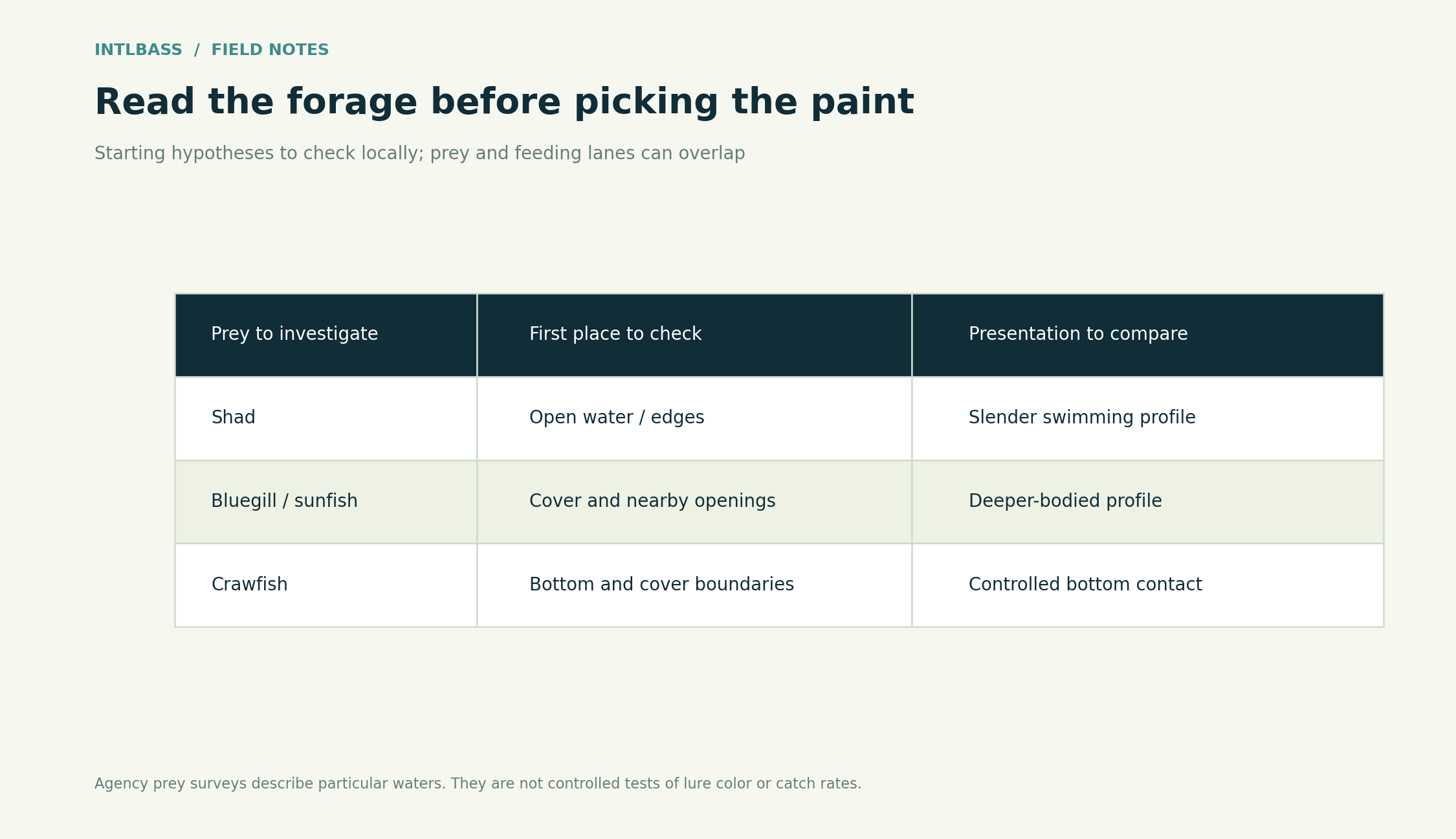
Rather than guessing based on tackle store trends, treat shad, sunfish, and crayfish as three starting hypotheses. While their distributions can overlap—such as young sunfish venturing over shallow gravel or shad pushed tight to riprap banks—each prey class generally demands a distinct predatory posture from bass.
- Open-Water Schooling Baitfish (Shad): Slender, compressed, silvery forage that school in open zones. They rely on group evasion, directional speed, and open corridors near main-lake points, humps, and channel swings.
- Cover-Oriented Panfish (Bluegill and Other Sunfishes): Deep-bodied, disc-shaped fish with tall vertical profiles. Sunfish utilize docks, aquatic vegetation, timber, and shoreline brush for protection, rarely lingering in barren open water.
- Benthic Invertebrates (Crayfish): Segmented, bottom-associated prey that shelter under rock, timber, or hard clay. Their defense relies on substrate concealment and short backward tail flicks along the lakebed.
Understanding which group dominates your target area informs profile height, retrieve speed, and presentation depth. As covered in our Bass Habitat Guide: Depth, Water Temperature & Cover by Species, bass position themselves where physical structure concentrates prey efficiently.
Pelagic Shad: Open Water, Slender Profiles, and Fleet Speed
According to the TPWD threadfin shad species account, threadfin shad serve as a common and important forage species in many reservoirs and large river systems. However, agency biological data notes their vulnerability to winter die-offs and temperature sensitivity. Anglers should never assume every lake, pond, or river contains a viable shad population.
Where shad thrive, bass often hunt in coordinated horizontal lanes or push bait upward toward surface boundaries. Matching this forage category requires paying attention to three mechanical factors:
- Profile: Narrow, elongated silhouettes, generally displaying pale sides and dark dorsal accents.
- Operating Lane: Pelagic open water, suspending through the middle water column, over offshore structure, or near wind-blown secondary points.
- Movement: Rhythmic, continuous swimming punctuated by sudden, coordinated darting bursts.
Slender soft-plastic swimbaits, jerkbaits, and umbrella rigs allow anglers to match this open-water profile. For a structured breakdown of soft-body selections across different seasons, see our guide to Seasonal Swimbaits: Build a Paddletail Plan Around Forage and Cover.
Sunfish and Bluegill: Deep Bodies, Cover Orientation, and Nursery Cycles
In waters lacking pelagic baitfish, or within dense shallow cover where open-water species rarely penetrate, sunfishes represent a steady calorie source for largemouth bass. The Texas A&M bluegill account highlights that bluegill undergo repeated spawning cycles throughout the warm months. This reproductive habit provides a continuous supply of small, juvenile forage in shallow nursery habitats from late spring through late summer.
Unlike schooling shad, juvenile sunfish prioritize protective shelter. They hover around shallow vegetation edges, dock pilings, submerged brush, and riprap crevices. Bass routinely stalk these transition edges or ambush sunfish as they dart between hiding spots. Key characteristics include:
- Profile: Deep, tall, oval silhouettes that displace significant water laterally.
- Operating Lane: Tied directly to physical cover—weed edges, shallow wood, boat docks, and shoreline boulders.
- Movement: Stop-and-start glides, stationary hovering, and abrupt defensive turning angles.
Presentations with tall profiles, such as bladed jigs, compact spinnerbaits, and squarebill crankbaits, match this water-displacement profile. Anglers tuning their blade configurations to mirror panfish vibration can reference our Spinnerbait & ChatterBait Blade Guide: Willow, Colorado, Indiana.

Crayfish: Substrate Contact and Low-Angle Evasion
Crayfish live in a wide range of natural lakes, rivers, and impoundments featuring broken rock, gravel, riprap, or firm bottom substrates. They provide dense, solitary meals that bass hunt along benthic contours.
Crayfish often use bottom cover and can escape with a backward tail movement. A bottom-contact presentation is one useful hypothesis, but swimming or lifting a craw-style bait can also catch bass. Its success does not by itself establish what the fish was eating.
- Profile: Segmented bodies with trailing antennae, defensive claws, and earthy, mottled tones.
- Operating Lane: Continuous contact with the bottom substrate, including rock transitions, riprap toes, and hard clay shelves.
- Movement: Steady, deliberate creeping interrupted by quick, low-angle hops that remain close to the lakebed.
Water-Specific Prey: Examining Agency Survey Data
Anglers frequently assume that regional forage hierarchies apply universally to every nearby body of water. Comparing biological sampling records from state agencies shows that forage availability varies drastically by water body.
Consider two contrasting fisheries surveys conducted by the Texas Parks and Wildlife Department. In the TPWD Lake Bryan survey, biologists documented sunfishes as the dominant prey base, with shad present only in limited numbers. By contrast, the TPWD Lake Palestine survey recorded an abundant threadfin shad population serving as a primary open-water prey engine.
These agency reports are observations of prey abundance, not controlled tests of fishing lure performance. However, they demonstrate why anglers must verify local forage rather than relying on generic regional assumptions. Running open-water baitfish patterns on a fishery dominated by sunfish ignores the primary food web, while failing to check for open-water shad schools on a reservoir with high pelagic bait numbers overlooks prime schooling zones.
Diagnostic On-Water Observations
Before selecting a lure, observe environmental cues to refine your initial prey hypothesis:
- Surface Activity: Broad, dimpling ripples over deep open water often indicate schooling shad. Sharp, popping disturbances deep inside emergent weed pockets frequently point to sunfish feeding on aquatic insects or fleeing shallow predators.
- Bank Substrate: Solid riprap, chunk rock, and broken clay benches favor crayfish populations, whereas silt bottoms lined with vegetation generally foster panfish and macroinvertebrates.
- Sonar Returns: Broad, suspended, amorphous clouds off secondary points indicate schooling pelagic baitfish. Tight, solitary marks tucked closely against wood branches or dock pilings indicate cover-oriented prey.
- Livewell Evidence: Regurgitated biological material provides direct confirmation of what bass recently fed on, showing whether they are consuming armored crayfish, slender shad, or broad sunfish scales.
Worked Comparison: The Two-Lure Diagnostic Test
To evaluate a fishery without preconceived notions, implement a two-lure test across the same structural zone. For example, consider an angler fishing a primary point in late spring where broken rock transitions into a submerged timber line in 6 to 14 feet of water. Rather than randomly changing lure colors, test two opposing prey behaviors:
- Lure A (Benthic Crayfish Hypothesis): A 3/8-ounce dragging jig paired with a twin-tail craw trailer. Work the lure strictly along the bottom, maintaining continuous contact across the rock-and-gravel transition from 14 feet up to 6 feet. This compares a bottom-oriented presentation; a bite does not prove that the fish was feeding on crayfish.
- Lure B (Horizontal Baitfish/Panfish Hypothesis): A 3/8-ounce bladed vibrating jig or 3.5-inch swimbait. Retrieve the bait horizontally through the middle water column, ticking the tops of the submerged timber 4 to 6 feet below the surface. This compares a swimming presentation above the bottom, without establishing which prey the fish intended to intercept.
By fishing both presentations across several matching structural points, the angler observes how bass respond to depth lane and movement. If bites occur exclusively on the bottom drag, the angler commits to bottom-contact presentations. If strikes occur on the horizontal retrieve as the lure deflects off wood limbs, the bass have committed to intercepting swimming forage in the upper column. The test evaluates prey behavior and depth strata before fine-tuning bait shade.
Prey Characteristics Matrix
| Prey Class | Body Silhouette | Dominant Lane | Typical Evasion Motion |
|---|---|---|---|
| Threadfin / Gizzard Shad | Slender, laterally flat, pale silver/white sides | Mid-depth to surface open water | Continuous lateral cruising, swift schooling darts |
| Bluegill / Sunfish | Deep-bodied, tall oval disk, mottled bars | Cover boundaries (wood, docks, weedlines) | Hovering pauses, tight cornering, burst to cover |
| Crayfish | Segmented, armored body with prominent claws | Benthic substrate (rock, gravel, hard clay) | Slow crawling, low-angle backward tail snaps |
Execution Checklist
- Check Survey Records: Review state wildlife agency sampling data to verify whether shad, sunfish, or other species dominate the target water body.
- Identify the Hunting Lane: Determine whether bass are positioned along the bottom, suspended in the middle column, or pushed tight to cover edges.
- Match Physical Dimensions: Select lure length and body depth to mirror the size class of observed prey.
- Regulate Retrieve Cadence: Keep crayfish imitations in direct contact with the bottom, and maintain a steady swimming cadence for open-water baitfish presentations.
Frequently Asked Questions
How can I find out what forage species live in my local lake?
Review biological survey reports published by your state wildlife agency. Fisheries departments regularly publish electrofishing and netting summaries that outline species composition, including the abundance of shad, bluegill, and other forage. Visual scouting around boat ramps, weed beds, and examining regurgitated prey in livewells provide direct field confirmation.
Does water clarity determine which forage bass target?
Water clarity dictates sensory reception rather than forage availability. In clear water, bass track prey from greater distances using eyesight, making body profile and swimming cadence critical. In stained or turbid water, visual range drops, and bass rely more on lateral line detection to sense water displacement and vibration, regardless of whether they are hunting shad, sunfish, or crayfish.
When is matching crayfish most effective?
Try a crayfish-style presentation around suitable bottom cover, then compare its results with a swimming bait. Season and weather may inform the test, but neither makes a craw imitation universally better.
Why are sunfish imitations effective around boat docks and wood?
Sunfish rely on solid physical cover for protection and feeding. Bluegill frequently graze on algae, aquatic insects, and larvae clinging to dock pilings, fallen trees, and weedlines. Bass use this same cover as ambush stations, making wide-bodied jigs, bladed lures, and squarebill crankbaits natural choices in these tight zones.
Leave a Reply