 International Bass Fishing™
Alabama Bass: Identification, Habitat & Fishing Guide
BLACK BASS / Centrarchidae · Source review: October 10, 2026
Native in one drainage, a serious conservation problem when moved to others. This guide distinguishes identification, habitat and distribution evidence, then connects them to practical fishing questions. Explore the original 360° adult-form illustration, map references and the linked fisheries or scientific sources.
INTLBASS™ / 360° FIELD STUDY
Alabama bass
Micropterus henshalli · Centrarchidae
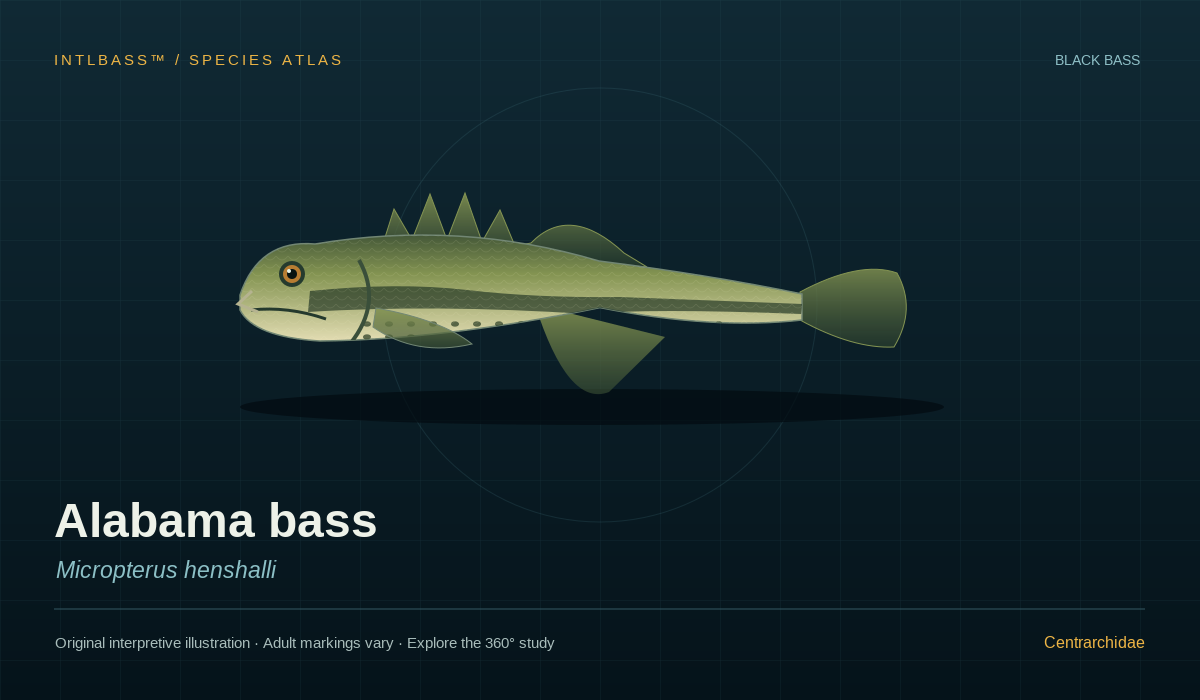
Drag to orbit · Scroll or pinch to zoom · Arrow keys rotate · Shift + arrows move · R resets
Comparison uses equal illustrated body length, not actual adult size.
Loading the interactive illustration…
Not native to North Carolina. Follow the current agency reporting and management guidance for the water you fish.
Illustration accuracy & sources
Original IntlBass 3D artwork with source-informed silhouette, fin layout and representative adult markings. This is an interpretive illustration, not a specimen scan, measured anatomical reconstruction, genetic test or identification key. Fin-ray counts, teeth, sex, age, regional forms and fine-scale proportions are simplified. Individual colors and markings vary. Largemouth and Florida bass deliberately share closely similar anatomy.
- NC Wildlife · Alabama bass identification and impacts ↗
- USGS · Alabama bass occurrence database ↗
- NC Wildlife · April 2025 distribution update ↗
Source review: October 10, 2026. Text and maps below explain identification limits.
At a glance
- Scientific name
- Micropterus henshalli
- Family / group
- Centrarchidae / Black bass
- Habitat
- Rivers and reservoirs; introduced populations can alter other black bass fisheries.
- Distribution context
- Native to the Mobile Bay basin; introduced in multiple other US drainages.
- Food & life stage
- A predatory black bass; ecological impacts include competition and hybridization.
- Reproduction
- Black bass reproductive biology; local genetics and monitoring matter.
Identification cues
- Spotted-type lateral pattern and lower-flank spots.
- Often called “spotted bass” by anglers.
- Use drainage records and expert identification; color is insufficient.
Not native to North Carolina. Follow the current agency reporting and management guidance for the water you fish.
Understand the identity and its limits
Alabama bass are a separate species, Micropterus henshalli, despite frequent angler use of the name “spotted bass.” Appearance overlaps with other spotted-type black bass and hybrids. The watershed, management history and expert identification can therefore be more useful than a single photograph. Do not treat a tongue patch, body color or our illustrative markings as a stand-alone species test.
Connect the biology to the water
The native reference is the Mobile Bay basin. Introductions into other drainages have a different ecological meaning. North Carolina’s fisheries agency describes Alabama bass as nonnative there and documents competition and hybridization concerns for existing black bass fisheries. The USGS occurrence account adds geographic evidence, but an occurrence point does not establish current abundance, public access or a legal fishing opportunity.
DISTRIBUTION / SOURCE-LINKED REGIONS
Put the biology on the map.
Approximate reference regions described in the linked sources. Pins are geographic orientation points, not verified fish sightings, fishing spots, launches or complete range boundaries.
USGS native-basin reference; not the whole state of Alabama.
Read the evidence ↗NC Wildlife documents early introductions in this border lake.
Read the evidence ↗NC Wildlife reports Alabama bass documented here in 2001.
Read the evidence ↗A practical learning path, from the first cast onward
Start here: First establish which bass the local authority reports in the water you intend to fish. In North Carolina, read the agency’s Alabama bass information before using a general “spotted bass” guide. Select public access and a manageable river or reservoir section; record the fish as uncertain if the evidence does not support a confident identification.
Build the next skill: Keep habitat notes separate from species certainty. A productive cover or current pattern can be useful even when a catch needs expert review. Compare agency identification material and document the watershed so that a later review has geographic context rather than only an image.
Advanced practice: Use local management information to decide how catch observations should be recorded or reported. A source describing a spreading introduction is not a trophy-fish promotion. Avoid combining historical spotted-bass records with modern Alabama-bass records unless the record keeper explicitly resolves the category.
These are editorial practice suggestions informed by the biology above. They are not tested catch-rate comparisons, guarantees, current local regulations or endorsements of a particular product. Read a water-specific fishery guide before applying a general technique.
Conservation, access and useful next steps
Follow the agency’s current fish-movement, reporting and management instructions for the water. Unauthorized relocation can damage native fish diversity. Our Lake Norman guide links to the North Carolina source so anglers can interpret that reservoir’s fishery with the necessary context.
Continue with Lake Norman, spotted bass and native-bass conservation. Use the Gear directory to compare equipment categories, and the tournament hub for organizer links and event information.
Use records as evidence, not as a species definition
Open the records and sources section and verify the originating authority’s current listing. Preserve the species name used by that authority, the water, catch date, category, original units and measurement method. An all-tackle weight, a line-class weight, a catch-and-release length and a biological maximum are different claims. Missing information should remain missing; it should not be supplied from a fish photograph or its apparent size.
Primary references for this field study
- NC Wildlife · Alabama bass identification and impacts ↗
- USGS · Alabama bass occurrence database ↗
- NC Wildlife · April 2025 distribution update ↗
Illustrations simplify adult shape, markings and external structures. They are not specimen scans or measured reconstructions. Map points are approximate source-described references, not observation records, public fishing spots, depth charts or complete range boundaries. Read the source’s date, taxonomy and geographic scope before reusing its claims.
KEEP EXPLORING
Different fish. Connected stories.
 Black bass
Spotted bass
Micropterus punctulatus
Rows of flank spots—and an identification trap with Alabama bass.
 Black bass
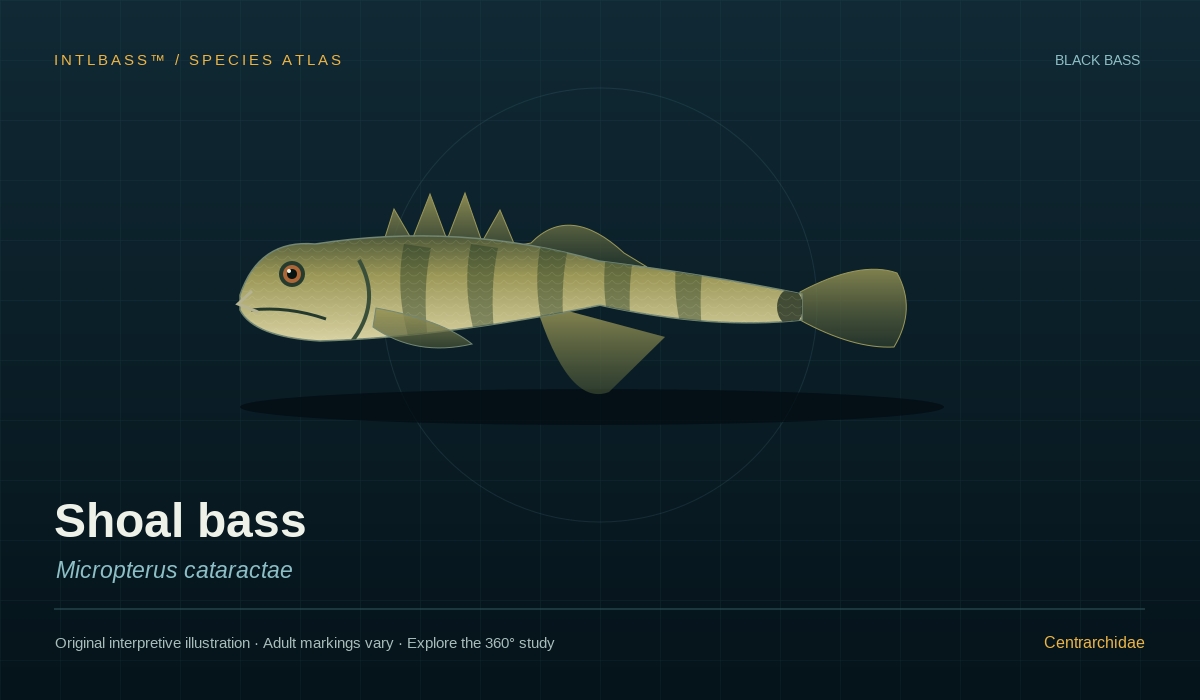
Shoal bass
Micropterus cataractae
A river specialist defined by current, rock and drainage history.
 Black bass
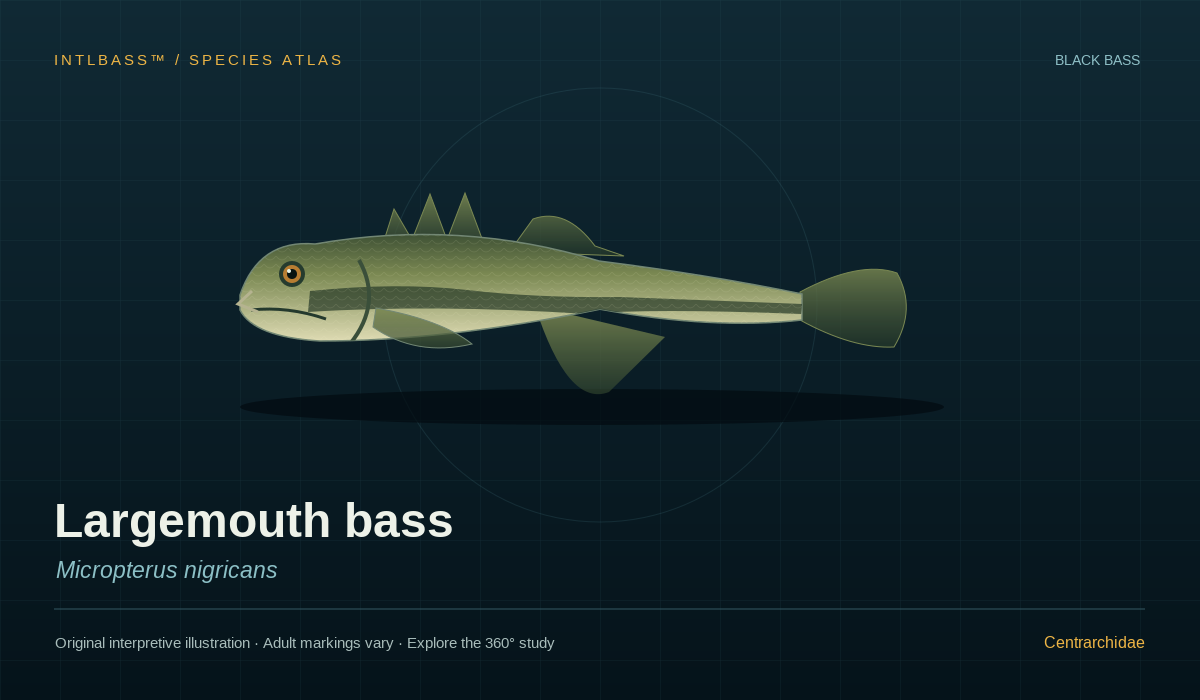
Largemouth bass
Micropterus nigricans
The cover-oriented predator behind so much of bass fishing.