 International Bass Fishing™
THE DEPTH CHART / GEAR
Your line is the only thing touching the fish.
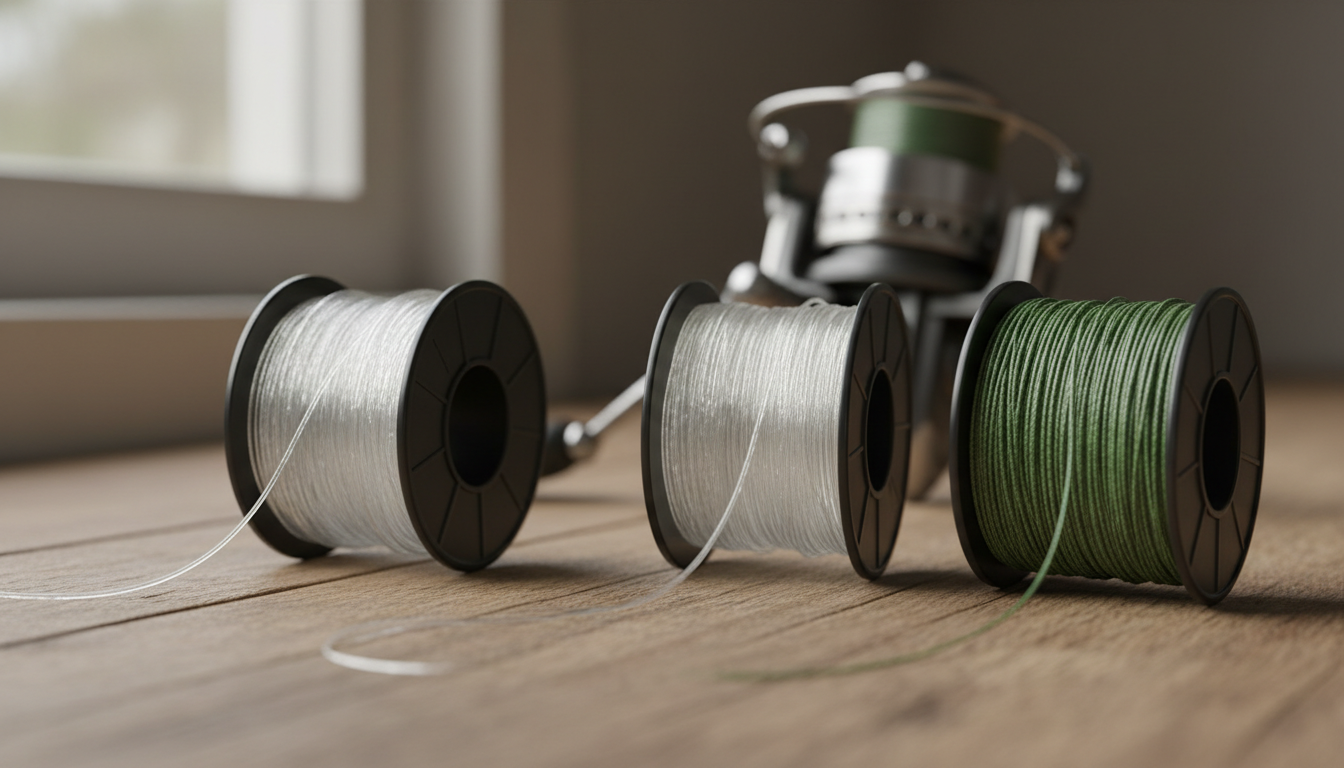
Mono, fluorocarbon and braid are made from three different plastics, and their physics, not the marketing, decides which one fits a technique. Here is what the material data says about sinking, stretch and visibility, and how to turn that into spool choices.
Line arguments in bass fishing get loud fast. Fluorocarbon is “invisible.” Braid “has no stretch.” Mono is “old school.” Each claim has a grain of truth and a lot of exaggeration. The useful way to choose is to start with what each line is made of, because the material decides how it behaves in water. Then match those behaviors to the technique on the end of the line.
If you're putting together a first outfit, our beginner's guide and gear hub cover rods and reels. This piece is just about the string.

Materials
Three lines, three materials
Monofilament is a single extruded strand, almost always nylon. Nylon has been around since DuPont's Wallace Carothers first synthesized nylon 66 in February 1935, and mono is still described as the most common type of fishing line.
Fluorocarbon fishing line is a single strand too, but made from polyvinylidene fluoride (PVDF), a fluoropolymer. Wikipedia notes that PVDF is used for specialty monofilament fishing lines sold as fluorocarbon. Seaguar is the line brand of Japan's Kureha, which also makes PVDF resin; Kureha says it developed and launched Seaguar, the first fluorocarbon (PVDF) fishing line, in 1971, and Seaguar's own site makes the same 1971 claim.
Braid (often called superline) is woven from many fine fibers of ultra-high-molecular-weight polyethylene (UHMWPE), sold under fiber names such as Dyneema and Spectra. Berkley, for example, describes its x9 braid as 100% PE fibers in nine strands; Seaguar's Smackdown uses eight.
| Monofilament | Fluorocarbon | Braid | |
|---|---|---|---|
| Material | Nylon | PVDF (fluoropolymer) | UHMWPE fibers, woven |
| Density (g/cm³) | ~1.13–1.15 (nylon) | ~1.77–1.79 (PVDF) | ~0.93–0.97 (UHMWPE) |
| In water | Slightly denser than water; described as buoyant | Sinks fastest of the three | Floats on its own |
| Stretch | Most | Less than mono | Little to none |
| Water uptake | Hygroscopic (absorbs moisture) | Very little | Very little (<0.01% for UHMWPE plastic) |
| Diameter for strength | Thicker than braid | Varies by brand; check the label | Thinnest: 20 lb Smackdown ≈ 6 lb mono diameter |
| Sunlight / UV | Not quantified here | Arkema: PVDF resins unaffected by sunlight | UV can damage UHMWPE rope in practice |
Densities: Kureha KF Polymer PVDF (1.77–1.79), Arkema Kynar PVDF (1.75–1.79), Goodfellow nylon 6 (1.13), Wikipedia (Nylon 1.15; PVDF 1.78; UHMWPE 0.93–0.94; Dyneema 0.97), Direct Plastics UHMWPE datasheet (0.930), DSM Dyneema brochure (density below 1). Behavior: Wikipedia (Fishing line), Seaguar FAQ and product pages, Berkley product pages. Densities are for the base plastics, not any specific line; coatings, dyes and blends change real lines.
One caution on that table: those densities are for the base plastics. Real lines add coatings, dyes, copolymers and (in braid) the air trapped in the weave. Treat the numbers as the physics underneath, not a spec for the spool on your reel.

Density
Sink or float: density decides
Specific gravity is density compared to water. Anything with a specific gravity below 1 floats in water, and anything above 1 sinks. That one rule explains most of the practical differences between the three lines.
Density of line materials vs water
g/cm³. Above 1.00 sinks; below 1.00 floats.
- Fluorocarbon is far denser than water, so it sinks. Seaguar says it has a faster sink rate than mono or braid, and Berkley sells its fluoro as fast-sinking with greater line density. That helps bottom baits, crankbaits that need to dive, and jerkbaits you want to hang a little deeper.
- Mono is only slightly denser than water. In practice it behaves as buoyant line: Wikipedia's fishing line article lists buoyancy among the reasons anglers pick it. That is a plus for topwaters, because a floating line doesn't drag the nose of a walking bait or popper down.
- Braid is lighter than water. DSM, which makes Dyneema, says the fiber has a density below one and floats on water, and Dyneema hawsers float on seawater. On the surface that's ideal for frogs; under the surface, a floating main line can bow and lift a bottom bait, which is one reason many anglers add a fluorocarbon leader.
Stretch
Stretch, feel and hook sets
Stretch is the biggest handling difference, and it cuts both ways.
Mono: the shock absorber
Mono stretches under load, which cushions hook sets and head shakes. That's forgiving with treble-hook baits and light-wire hooks, and for beginners. The cost is a spongier feel at long distance.
Fluorocarbon: in between
Seaguar's own FAQ says fluorocarbon does stretch, but not as much as mono. It feels more direct than mono and is often described as sensitive, but it's not stretch-free.
Braid: almost direct
Superlines are known for their lack of stretch, and Seaguar describes Smackdown as having little or no stretch. You feel bottom and bites clearly, and hook sets travel fast through heavy cover. The trade-off is less cushion, so drag settings matter more.
That is why drag is part of line choice. Missouri's Department of Conservation tells anglers to set drag so it slips before the line's breaking point. With braid, the drag (and a softer rod) does the cushioning that mono's stretch would otherwise do.
Visibility
Visibility: what we know and what we don't
Fluorocarbon's reputation rests on refraction. A line is easier to see underwater when light bends very differently through it than through the water around it. Water's refractive index is about 1.333. PVDF makers put it at about 1.42: Kureha lists 1.42 for its KF Polymer, and Arkema lists its Kynar grades at 1.40 to 1.42. Nylon is higher; materials supplier Goodfellow lists 1.53 for nylon 6. (Seaguar's FAQ gives water 1.33 and fluorocarbon 1.42, matching those sources, but lists nylon at 1.62, higher than the independent figure we found.)
Refractive index: water vs line materials
Closer to water = less light bending at the line's surface
So fluorocarbon is closer to water optically than nylon. That's a real material difference. What it means to a bass is less certain. Even Seaguar says fluorocarbon is “virtually invisible, but not completely”, and that a line you can see isn't necessarily one a fish can see. We haven't found controlled research that settles how much line visibility changes bass catch rates, so treat any absolute claim (including “bass never see braid” or “fluoro is invisible”) as marketing, not science.
Diameter is a factor nobody disputes much: Wikipedia's tackle article notes that thicker lines are more visible to fish. In very clear water, going lighter and thinner is a lower-risk change than switching brands. Braid's thin diameter is one reason many anglers use it with a short fluorocarbon leader.

Spool choices
Pick by technique
Here's how those properties line up with common bass techniques. This grid is a starting point; plenty of good anglers break it.
Line-by-technique planner
Starting points, not rules
| Technique | Monofilament | Fluorocarbon | Braid (+ leader?) |
|---|---|---|---|
| Topwater walking bait / popper | Floats; stretch helps trebles | Sinks; drags the nose down | Floats; add mono leader if fish miss |
| Hollow-body frog in matted cover | Too stretchy for heavy cover | Sinks into the mat | Straight braid: cuts grass, no stretch |
| Texas rig / jig in wood | Workable, more stretch | Sinks, abrasion resistant | Heavy cover: straight braid or braid + fluoro |
| Drop shot / Ned rig (finesse) | Light mono is fine | Common main line or leader | Thin braid main + fluoro leader |
| Crankbait | Stretch keeps trebles pinned | Helps reach depth | Very direct; can pull hooks |
| Jerkbait | Floats; keeps bait shallower | Sinks; suspends bait slightly deeper | Braid + fluoro leader |
| Spinnerbait / bladed jig | Fine | Fine | Good in grass |
For technique-specific setups, see our Texas rig guide, drop shot guide, crankbait depth guide and topwater guide. Fishing from shore over rocks? Our bank fishing playbook explains why abrasion resistance matters there.
Conditions matter too. Wind bows a light, floating line and makes it harder to feel a bait, while a dense fluorocarbon or a thin braid cuts through better. Check the breeze before you pick a rod for the day:
Live conditions
Wind check before you choose line
Loading live conditions…
Air conditions from the Open-Meteo forecast model, refreshed when the page loads. This is not water temperature, a fishing forecast or a marine warning — check the National Weather Service and your lake operator before launching.

Knots & care
Knots, care and disposal
Each line type ties differently. Mono is forgiving and Berkley pitches it for excellent knot strength. Fluorocarbon is stiffer and needs care when you cinch it. Braid is slick, because UHMWPE has a very low coefficient of friction, so simple knots can slip unless you use knots designed for braid.
- Wet every knot before you tighten it. MDC's improved clinch instructions call for about ten half-turns, moistening the line so the knot comes together more smoothly, and trimming the tag about a quarter inch from the knot (MDC).
- Pull it down slowly and fully. A knot that isn't fully seated can slip or break at a lower load.
- Use a line-to-leader knot for braid + fluoro. Seaguar calls the FG knot one of the most praised line-to-leader connections, and its knot guide has video walk-throughs.
- Retie after every big fish or snag. Run the last few feet through your fingers; if it feels rough or kinked, cut it off.
- Store spools out of the sun. UHMWPE rope can be damaged by UV in practice, and nylon is hygroscopic. Arkema says PVDF resins are unaffected by sunlight, but dyes and coatings in finished lines may not be.
Never wrap braid around bare fingers to break it off a snag; it can cut skin. Wrap it around a reel handle, a stick or a cloth and walk back slowly, keeping your face away from the line. And take every scrap of old line home: MDC asks anglers to bin fishing line because it harms wildlife.
Want hands-on help with rigging? NCWRC's John E. Pechmann Fishing Education Center runs free programs (pre-registration required); check its calendar before you go.
FAQ
Fishing line FAQ
Is fluorocarbon really invisible to bass?
No line is invisible. Fluorocarbon's refractive index is closer to water's than nylon's, which should reduce glare, but Seaguar itself says it's not completely invisible. How much that changes bites isn't settled by research we've found.
Can I use fluorocarbon for topwater?
It works, but it sinks, so it can pull the nose of a walking bait or popper down over a long retrieve. Mono, or braid with a short mono leader, keeps topwaters riding higher.
Why do people put a fluorocarbon leader on braid?
To combine braid's thin diameter, sensitivity and lack of stretch with a less conspicuous, abrasion-resistant, sinking section near the bait. It also adds a little stretch at the business end.
Does braid float?
The fiber does. UHMWPE is less dense than water, and Dyneema ropes float on seawater. Either way, braid won't help a bait get deeper the way dense fluorocarbon does.
What pound test should a beginner use?
For general bass fishing, many anglers start with mid-weight mono because it's forgiving and cheap. For panfish sampling in ponds, MDC uses 2 to 6 lb line. Match line to rod rating and cover more than to fish size.
Sources / review date
Built on sources you can check.
Reviewed October 17, 2026. Regulations, access and conditions change; confirm with the agency or operator before you go. Tactics are original IntlBass guidance, not guarantees. See our editorial standards; send corrections through Contact.
- Wikipedia: Fishing line — Mono buoyancy and stretch; fluorocarbon refraction and density; superline stretch
- Wikipedia: Fishing tackle — Mono most common; thicker line more visible
- Wikipedia: Nylon — Density 1.15 g/cm³; hygroscopic; 1935 synthesis
- Wikipedia: Polyvinylidene fluoride — Density 1.78 g/cm³; use in fluorocarbon line
- Arkema: Kynar PVDF typical properties (PDF) — Specific gravity, refractive index, water absorption, sunlight resistance
- Wikipedia: UHMWPE — Density, fishing line use, friction, UV
- Wikipedia: Dyneema — SK75 density 0.97; floats on seawater
- Direct Plastics: UHMWPE datasheet (PDF) — Density 0.930; water absorption
- Wikipedia: Specific gravity — Float/sink rule
- Wikipedia: Refractive index — Water 1.333
- Seaguar: Understanding Fluorocarbon & FAQs — Refractive index figures, sink rate, stretch, visibility caveats
- Seaguar: Quality assurance — Fluorocarbon line invented 1971
- Kureha: Seaguar fishing line — Kureha developed Seaguar PVDF line in 1971; high specific gravity
- Kureha: KF Polymer (PVDF) properties — Specific gravity 1.77–1.79; refractive index 1.42
- Goodfellow: Nylon 6 properties — Density 1.13; refractive index 1.53
- DSM Dyneema: marine and industrial applications brochure (PDF) — Density below 1; floats on water
- Seaguar: Smackdown braid — 8-strand; 20 lb ≈ 6 lb mono diameter; little or no stretch
- Seaguar: FG knot and Knot Guide — Line-to-leader knot
- Berkley: Trilene 100% Fluorocarbon — Fast-sinking, greater density
- Berkley: Monofilament — Handling and knot strength
- Berkley: x9 Braid — PE fibers, nine strands
- Missouri Dept. of Conservation: Rigging Your Pole — Drag and improved clinch knot
- MDC: Fishing Ethics — Line disposal
- MDC: How Many Fish Do I Have? — Light line for bluegill sampling
- NCWRC: John E. Pechmann Fishing Education Center — Programs and registration
- Wikipedia: Lake Norman, Lake Fork, Lake Okeechobee, Lake St. Clair — Weather widget coordinates
Leave a Reply