 International Bass Fishing™
The Depth Chart / Field Notes · 6 minute read
Prepare for your first competitive bass tournament with this comprehensive guide to choosing formats, verifying registration paperwork, understanding rules, planning a realistic budget, and executing an orderly day on the water.


Stepping from casual weekend angling into organized competitive bass fishing changes how you evaluate water, manage time, and handle your equipment. While everyday fishing lets you wait out a slow bite or trailer the boat when weather rolls in, a tournament demands disciplined preparation under an unyielding schedule. Succeeding in your debut is less about winning a trophy and more about arriving fully documented, operating safely, avoiding procedural penalties, and executing an orderly day on the water.
Choosing a Competition Format
Tournament bass fishing is not structured under a single universal ruleset. Different circuits organize events around specific boat configurations, technological boundaries, and angler skill levels. Understanding the distinctions among these formats helps you select a competition that aligns with your equipment and realistic goals.
- Team Events: In team formats, two anglers share a boat, fish as a unit, and pool their combined catch into a single tournament limit. For beginners, partnering with an experienced boater or a dependable friend divides launch fees, tow fuel, and navigational duties while smoothing out early-morning ramp operations.
- Kayak Divisions: Many kayak tournaments use digital catch-photo-release (CPR) protocols rather than aerated livewells. In those formats, anglers land a bass, measure it on an approved measuring board with an official identifier token, photograph the catch using a mobile application, and release the fish immediately.
- Pro-Am and Draw Formats: Historical draw events paired a boat owner with an unassigned non-boater (often designated as a co-angler) fishing from the back deck for a separate prize pool. However, these programs vary widely across organizations and continue to shift. Notably, B.A.S.S. officially announced the elimination of the Opens co-angler program for 2025, moving that platform to an all-boater model. Anglers should never assume an older article or historic tournament structure guarantees current co-angler openings; always confirm direct entry paths with the current circuit director.
- Club Tournaments: Local bass clubs offer low-pressure entry points. Because fields are typically smaller, clubs provide practical opportunities to learn staging decorum, weigh-in queues, and basic fish-care techniques from veteran members.
Locating Verified Events and Checking Sanctioning
Finding a tournament starts by cross-referencing reliable schedules and examining individual event sanctioning. A comprehensive directory such as Bass Fishing Tournaments by State offers a broad snapshot of regional and local listings. However, an independent calendar entry or community listing does not automatically mean an event is officially sanctioned by a national governing body. Anglers must confirm the sanctioning status directly on the event organizer’s official page.
If you track premier professional circuits, consult the official Bassmaster schedule or the MLF schedule. While top-tier circuits host major national contests, their affiliated developmental trails also publish entry requirements, membership criteria, and division-specific requirements that provide a clear picture of formal competitive standards.
Navigating Tournament Rules Versus Statutory Law
A common misconception among first-time competitors is that tournament regulations simply copy state wildlife codes. In practice, both statutory fishing laws and private tournament rules apply simultaneously. You must comply with all state and federal boating and wildlife statutes, and you must also obey the organizer’s specific rules, which may set additional operational constraints.
For example, state regulations establish legal minimum length limits, standard bag limits, and statutory safety requirements on public waterways. Tournament rules, however, may establish higher minimum fish lengths, require non-penetrating cull clips, set strict off-limits practice periods, or mandate specific electronic equipment configurations. The official 2027 Bassmaster Opens schedule, for instance, has two divisions and publishes dedicated resources for rules, registration, technology, and practice. Anglers should review the official Bassmaster Opens resources for current guidelines rather than relying on hearsay.

Worked Comparison: Solo Boater vs. Team Trail Formats
Choosing between fishing your debut event as a solo boater or as part of a two-person team alters your operational focus and logistical burden. The following comparison highlights the trade-offs between both structures:
- Operational Burden: A solo boater handles boat launch, navigation, livewell monitoring, fish care, netting, and clock management alone. In a team format, responsibilities are split: one partner can manage the net and monitor livewell aeration switches while the other controls boat position with the trolling motor.
- Decision-Making Dynamics: Solo boaters retain total authority over spot rotation and lure adjustments, eliminating disagreement. Teams must communicate efficiently regarding water selection and lure pacing, requiring mutual agreement on when to leave an unproductive area.
- Financial Distribution: Solo competitors absorb entry fees, outboard gas, and vehicle travel costs entirely on their own. Team trails allow partners to share direct expenses, substantially lowering individual financial exposure.
Administrative Verification and Boat Documentation
Administrative oversights can disqualify an angler before launch. While not every small event requires complex insurance binders, organized trails commonly require verification of both personal licensing and vessel documentation. Consult our overview on Tournament Registration & Rules to ensure your paperwork is organized.
| Requirement | Standard Verification Form | Why the Test Matters |
|---|---|---|
| State Fishing License | Physical card or digital permit | Ensures statutory compliance with state wildlife agencies. |
| Watercraft Liability Insurance | Policy declaration page | Verifies valid watercraft coverage and policyholder identity. |
| Engine Cut-Off Switch | Functional test of safety clip/lanyard | Confirms ignition cuts instantly if the driver leaves the helm. |
| Livewell Aeration & Recirculation | Operational pump inspection | Ensures proper oxygenation and water movement to maintain fish health. |
Realistic Budgeting: A Hypothetical $500 Travel Model
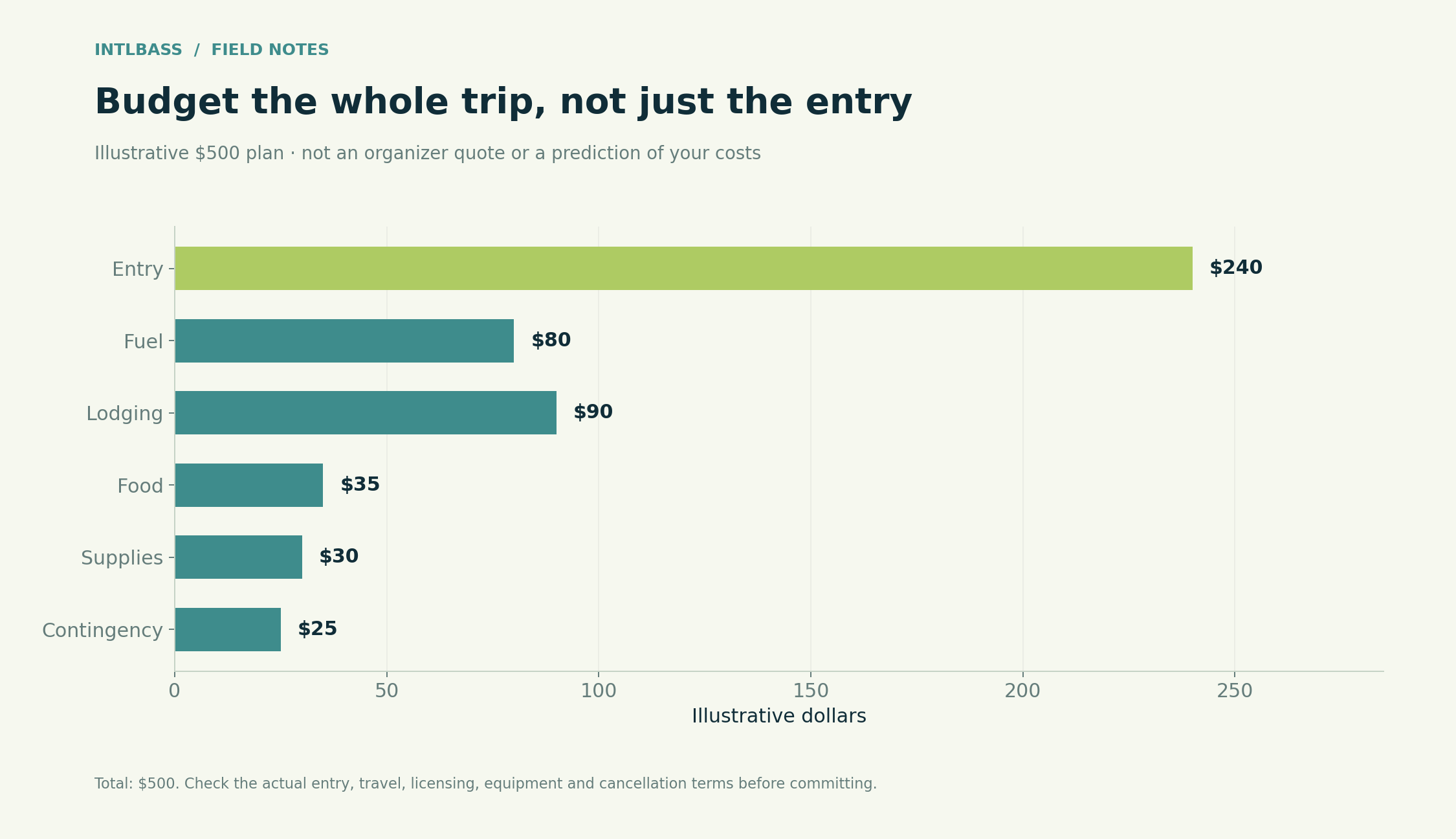
Financial discipline is an essential aspect of tournament fishing. Novices often budget strictly for the registration fee, only to experience budget strain when lodging, highway fuel, marine fuel, and replacement tackle accumulate. To illustrate how direct expenses assemble over a weekend, examine the following hypothetical $500 model.
This breakdown is purely an illustrative planning example. It is not an official fee schedule, entry quote, or binding cost estimate for any specific tournament trail:
- Entry Fee: $240
- Vehicle & Outboard Fuel: $80
- Lodging (Single Night): $90
- Food & Ice: $35
- Supplies & Terminal Tackle: $30
- Contingency Reserve: $25
- Total Illustrative Trip Cost: $500
In this illustrative budget, the registration fee represents almost half of your total trip outlay. Lodging is the second largest line item in this particular example, followed by fuel. Your actual cost order may be very different. The $25 contingency reserve provides a minimal cushion for minor unexpected needs, such as a replacement drain plug, trailer fuse, or ramp launch fee.
If you plan to explore an unfamiliar lake, practice days will increase fuel consumption, launch expenses, and lodging costs. For a structured approach to mapping productive water during practice, review our practical guide on how to Break Down an Unfamiliar Bass Lake: A Tournament Practice Plan.
Orderly Tournament-Day Execution
Tournament mornings move quickly. Creating a repeatable routine prevents procedural slip-ups and equipment failures when boat traffic is high.
- Ramp Staging and Inspection: Arrive early enough to park, install your drain plug, secure dock lines, and disconnect trailer tie-downs before approaching the ramp lane. Be ready for officials to inspect livewells for standing water, legal species, or unauthorized bait.
- Blast-Off Staging: Idle off-plane to the designated staging zone. Keep your engine cut-off lanyard attached, wear your USCG-approved personal flotation device (PFD), and monitor your official boat number. Never jump wakes or crowd adjacent craft during launch calls.
- Fish Care and Livewell Maintenance: Have an appropriate livewell ready before retaining a fish. Run continuous recirculation or aeration to keep water oxygenated. Handle bass with wet hands, minimize carpet contact, and secure fish with non-puncturing culling tags.
- Check-In Timelines: Tournament check-in windows are strictly enforced. Synchronize your boat electronics with the official director’s clock during morning registration. Plan your run back to the ramp perimeter with ample margin to clear unexpected boat traffic or mechanical slowdowns. Arriving even seconds late can lead to heavy weight deductions or immediate catch disqualification under specific trail rules.
Leave a Reply