 International Bass Fishing™
The Depth Chart / Field Notes · 9 minute read
A weather front is not a magic bite switch. Understand how wind, light, and water clarity interact, explore the physics of barometric pressure versus water depth, and build a safe, tactical boat-positioning plan for changing conditions.


Few concepts in bass fishing attract as much folklore as weather fronts and barometric pressure. Anglers often speak of a falling barometer as a biological starting gun that forces bass to gorge, or a rising barometer as a heavy weight that glues them to the bottom. In reality, a weather front is not a single trigger. It is a package of simultaneous physical changes in wind velocity, wind direction, ambient light, water temperature, surface turbulence, and runoff.
A pressure trend can help you track an approaching weather system, but it does not supply a complete fishing plan. Wind, light, water clarity and temperature are observable variables you can compare on the water. Use them to form practical hypotheses about boat position, target selection and presentation.
The Front as a Bundle of Environmental Changes
In meteorology, a front is the transitional zone between two distinct air masses of differing temperature, density, and moisture. The National Weather Service overview of basic fronts and pressure systems explains that passing boundaries create rapid shifts in wind direction, wind speed, cloud cover, and precipitation. For a bass suspended around a laydown or cruising a secondary point, these atmospheric shifts manifest as immediate alterations to the aquatic habitat.
Before a cold front crosses a body of water, cloud decks typically thicken, decreasing ambient light. Surface winds increase, generating wave chop that disrupts the air-water interface and diminishes sunlight penetration. Behind the boundary, high-pressure air settles in, stripping away cloud cover, shifting wind directions, and introducing intense sunlight. When anglers face difficult fishing across these cycles, isolating which environmental variable shifted first is the most dependable path to solving the bite, as outlined in our diagnostic plan for tough bass fishing conditions.
Atmospheric Pressure vs. Hydrostatic Head
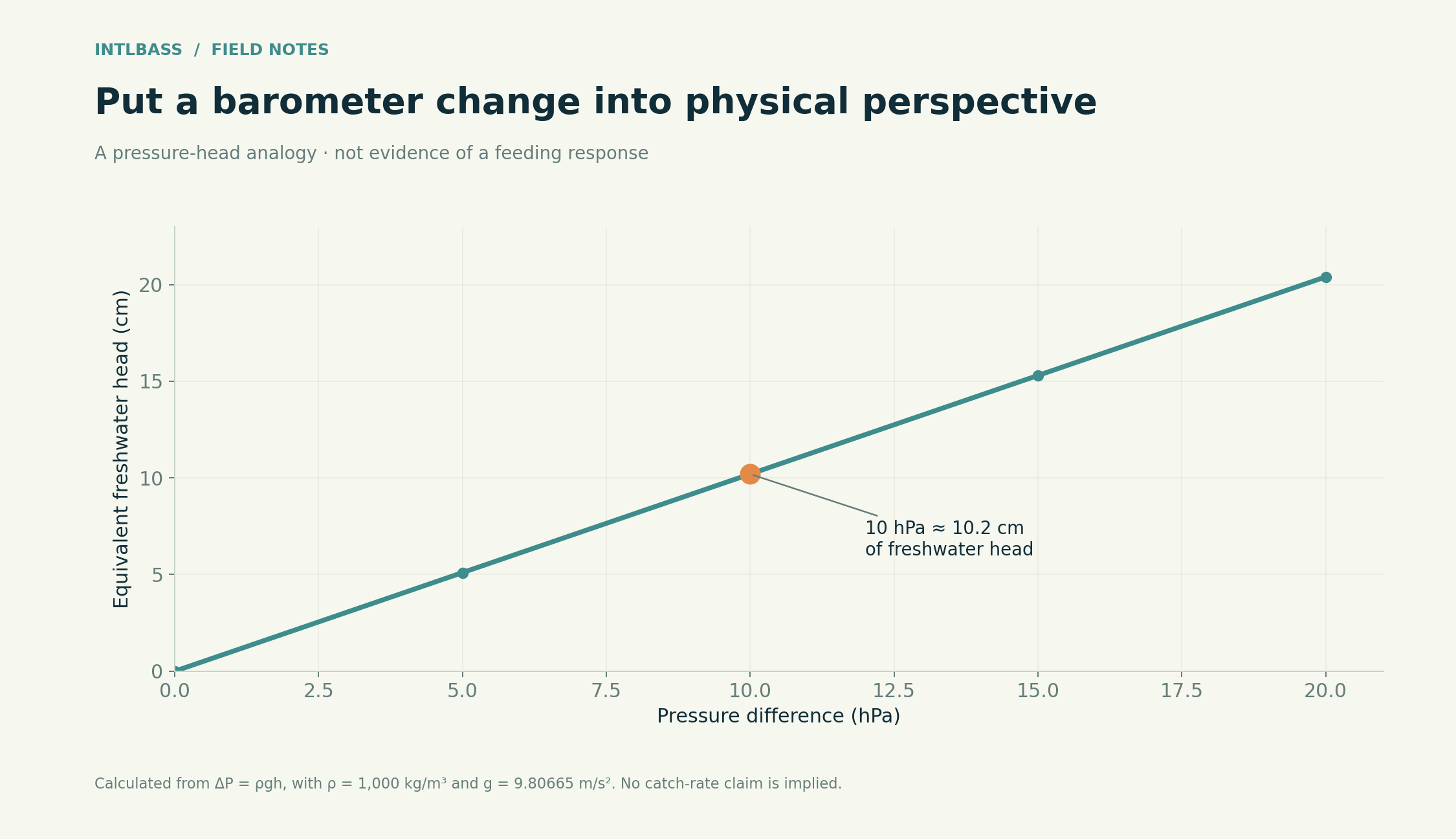
A longstanding theory on boat ramps suggests that changes in atmospheric pressure directly compress or expand a bass’s swim bladder, dictating its activity level. A straightforward physics calculation puts the magnitude of these atmospheric pressure shifts into perspective.
In freshwater, hydrostatic pressure increases directly with depth according to the equation:
ΔP = ρ × g × Δh
Where ρ is the density of freshwater (approximately 1,000 kg/m³), g is gravitational acceleration (standardized at 9.80665 m/s²), and Δh is the depth change in meters. Solving for depth yields:
Δh = ΔP / (ρ × g)
If atmospheric pressure changes by 10 hectopascals (10 hPa, which equals 1,000 pascals or about 0.30 inches of mercury), the corresponding depth change in freshwater is:
1,000 Pa / (1,000 kg/m³ × 9.80665 m/s²) ≈ 0.102 meters (about 10.2 centimeters or 4.0 inches)
This calculation compares the magnitude of two pressure differences. It does not establish how frequently bass change depth or whether a particular rate of atmospheric change affects feeding. Treat it as physical context rather than an experiment on fish behavior.
It is critical to interpret this comparison carefully. Demonstrating that a 10 hPa change equals 10.2 cm of hydrostatic head is a physics analogy, not biological proof of how a fish responds. It does not prove that bass are completely oblivious to pressure rates of change, nor does it prove that pressure is the primary driver of their behavior. Instead, it underscores that barometric trends are best treated as weather clues that signal shifting wind, light, and temperature, rather than direct physical forces that lock fish in place.

Light Penetration and Bass Positioning
Light is one variable worth testing after a front. Compare shaded and exposed cover, the depth at which bait appears, and the distance fish seem willing to move for a presentation. Avoid using a simplified explanation of fish vision to predict every bass’s response.
Where cloud cover and manageable wind create lower-light conditions, compare moving presentations along cover edges with a slower bait in the same general zone. Crankbaits, swimbaits and spinnerbait retrieves offer useful alternatives. Increased cloud does not guarantee feeding or a particular advantage over prey.
When clear skies follow a front, test shade, cover interiors and nearby depth changes alongside open-water targets. A slower presentation may help in one area while moving bait remains effective elsewhere. Let contacts guide the adjustment instead of declaring that all fish are pinned to the bottom.
Wind, Waves, and Current Dynamics
Wind direction and speed often shift dramatically around a frontal boundary. Wind generates surface waves that break surface reflection, scattering light and making bass bolder even during mid-day periods. Furthermore, sustained wind pushes warm surface water and drifts plankton into windward banks and points.
Baitfish follow this concentrated food source into the wave wash, creating productive feeding zones along exposed shorelines. However, wind-blown banks are not automatic guarantees of success. If prolonged wind churns shallow clay banks into zero-visibility mud, or if cold gale-force winds drop the surface temperature rapidly, fish may vacate the shallows for more stable breaks. When seasonal temperatures drop significantly, applying targeted principles from our guide to cold-water bass fishing helps identify where fish reposition along secondary contours.
Worked Tactical Comparison: Windward Structure vs. Protected Water
When selecting locations across a frontal transition, anglers generally face a choice between working exposed, windward structures or retreating into wind-sheltered pockets. This is not a matter of choosing a universally “correct” spot, but rather a conditional workflow based on navigation safety, boat control, water clarity, and forage presence.
Assessment Step 1: Safety and Travel Clearance
Before considering fish location, assess travel conditions. The National Weather Service inland boating guidance highlights that shifting winds across open water can rapidly generate hazardous chop and make vessel control dangerous. If safe navigation or trolling motor control is compromised on primary points, head immediately to sheltered secondary coves regardless of potential fish activity.
Assessment Step 2: Fishing Windward Structure
If winds permit safe boat operation and the bank has not blown out into dense mud, windward points and shorelines offer prime feeding zones ahead of an incoming front:
- Boat Position: Keep the boat positioned outside the target zone in deeper water, facing the bow directly into the oncoming waves. This allows continuous trolling motor control and can help you maintain a deliberate approach; adjust to your vessel and conditions.
- Casting Angle: Cast quartered into or across the wind, retrieving the bait with the natural movement of the waves. Forage organisms drift with the surface wash; bass face into that drift to intercept them.
- Presentation: Deploy active search baits with flash or vibration. Keep the retrieve moving at a moderate to fast clip to capitalize on the ambush instincts of active fish.
Assessment Step 3: Fishing Protected Water
Following frontal passage, sustained high winds, cold air, or bluebird skies often make windward banks unfishable or unproductive. Shifting to protected, lee-side pockets provides distinct tactical advantages:
- Boat Position: Position the boat quietly along the outside edges of visible cover. With minimal surface chop to hide vessel noise, keep a low profile and avoid rapid trolling motor bursts.
- Casting Angle: Align casts directly parallel to shadow lines cast by dock floats, overhanging trees, or vertical wood. Bass utilize these localized light breaks as overhead canopy.
- Presentation: Slow down and reduce bait profile. Pitch a compact jig, soft plastic creature, or weightless stickbait directly into the thickest interior branches or shade pockets, allowing it to soak with minimal horizontal movement.
Frontal Transition Workflow Matrix
Use this practical checklist to adjust your tactical approach as conditions evolve across a typical frontal cycle:
| Frontal Stage | Environmental Indicators | Location Hypothesis to Test | Recommended Tactical Plan |
|---|---|---|---|
| Approaching Front (Pre-Frontal) | Thickening clouds, falling light, increasing wind and wave chop | Roaming open edges, suspending off points, active ambush feeding | Cover water with moving reaction baits; make quartered casts along windward edges. |
| Frontal Passage (Active Boundary) | Rapid wind shift, rain squalls, temperature drop, turbulence | Holding tight to immediate current breaks or moving toward deeper staging zones | Stop fishing and reach suitable shelter ashore before dangerous weather arrives. |
| After Frontal Passage | Clearing bluebird skies, high sunlight, shifting or calm winds, air cooling | Tucked deeply inside heavy cover, dock shadows, or tight to bottom breaks | Downsize presentations; flip jigs or Texas rigs directly into the densest available cover. |
| Stabilizing Conditions (timing varies) | Consistent wind direction, stable solar patterns, settling water clarity | Gradually expanding feeding radius along primary structural edges | Combine moving search baits along outer grasslines with targeted vertical pitches to isolated wood. |
Common Misconceptions and Safety Realities
Refining your approach requires stripping away myths while keeping essential safety rules at the forefront:
- Myth: There is a magic barometric number that guarantees feeding. Anglers often search for an absolute threshold, such as 29.92 inHg or 1016 hPa, as an optimum feeding trigger. The National Weather Service glossary on atmospheric pressure emphasizes that baseline pressure varies by altitude and broader geographic air masses. It is the directional trend and the accompanying weather package that provide practical cues, not an arbitrary numerical dial setting.
- Myth: Post-frontal fish stop feeding entirely. Even if chasing behavior appears reduced, bass do not lose the biological capacity to feed. Try shade, cover and nearby depth, but verify any reduced strike window through actual observations.
- Safety Rule: Never chase a pre-frontal bite into a thunderstorm. Anglers frequently risk their lives trying to squeeze extra casts out of a building pre-frontal feeding window. The National Weather Service severe weather boating guidelines emphasize that squall lines routinely bring violent wind gusts, blinding downpours, and deadly lightning well ahead of the primary rain boundary. Plan your exit ashore before deteriorating weather traps you on open water.
Frequently Asked Questions
Does a falling barometer cause bass to feed aggressively?
A falling barometer alone is not a dependable catch prediction. Consider the wind, light, water temperature and local observations that accompany the weather system. This guide does not establish an independent causal effect of pressure on feeding.
How does atmospheric pressure compare to water pressure?
A meteorological pressure shift of 10 hPa exerts approximately 1,000 pascals of pressure. In freshwater, that same 1,000 pascals of hydrostatic pressure is exerted by a water column of roughly 10.2 centimeters (about 4 inches). This editorial calculation shows that a bass swimming up or down just four inches experiences an equivalent ambient pressure change. This physics comparison provides perspective on the magnitude of atmospheric pressure shifts, though it does not serve as biological proof of fish behavior.
Why is fishing often challenging immediately after a cold front?
A front can change wind, light, temperature and water conditions together. If the bite becomes difficult, compare shade, nearby depth and presentation speed. Fish do not all respond in one fixed way, and a clear sky does not establish that they have stopped chasing prey.
What is the most critical hazard when fishing ahead of a front?
The greatest risk is violent convective weather. Cold fronts and frontal squalls can generate sudden gale-force wind shifts, large waves, and deadly lightning with minimal warning. National Weather Service guidance urges boaters to monitor forecasts onshore and seek protected harbors well before storm boundaries arrive, rather than attempting to fish through an active squall.
Leave a Reply