 International Bass Fishing™
The Depth Chart / Field Notes · 9 minute read
Night bass fishing demands deliberate planning rather than daytime habits. Learn how to scout legal access, separate vessel lights from task lighting, trim your tackle to reliable essentials, and execute controlled presentations in the dark.


Fishing after dusk eliminates visual cues anglers rely on during the day. Distance perception drops, shoreline trees merge into flat silhouettes, and small deck hazards become genuine trip risks. Catching bass after dark does not require complicated gadgets or oversized tackle bags. Instead, steady success comes from deliberate preparation: choosing a body of water you already know, trimming your rods down to manageable tools, separating task lighting from vessel navigation lights, and executing controlled casts with tactile retrieves.
Familiar Waters Are Not Automatically Safe
Nighttime is never the right occasion to explore a lake you have never visited, trace unfamiliar timber fields, or hunt for uncharted brush piles. Darkness fundamentally changes spatial perception. Landmarks that look unmistakable at midday become ambiguous shapes against the night sky.
Guidance from the U.S. Coast Guard boating safety material points out that even bodies of water you know intimately look entirely different after dark. Distances are much harder to judge accurately across open water, and illuminated docks or residential streetlights along the shoreline can easily be confused with channel markers, navigational beacons, or oncoming vessels. Familiarity with a lake provides a baseline mental map, but it does not make the water inherently safe. You still need to know where hazardous rock shoals, shallow flats, bridge footings, and legal takeout ramps sit before setting out.
Verifying Legal Access and Inland Weather
Never assume an access point remains open simply because it was accessible at noon. Some public parks, conservation areas, state agency ramps, and municipal lakefronts close gates at sunset or enforce specific night curfews. Other ramps allow 24-hour boating access but prohibit vehicle parking past dusk without a special permit. Check posted rules and local administering agency regulations before you pull into the lot. Finding your vehicle locked behind an automated security gate turns a rewarding evening into a frustrating delay.
Weather demands disciplined evaluation before launch and continuous monitoring throughout the trip. The National Weather Service safe boating guidance stresses the necessity of checking up-to-date forecasts and establishing a plan to return to shore before hazardous conditions arrive. Darkness does not eliminate shifting wind fronts, sudden lightning, or fast-building squalls; it merely makes tracking incoming storm clouds by sight nearly impossible. Anglers should review regional radar trends, note forecast wind shifts, and set a non-negotiable departure time if conditions show signs of deteriorating.
Navigation Lights Versus Task Lighting
One of the most critical safety distinctions on the water is the difference between vessel navigation lights and personal task lights. Conflating these two tools creates severe legal issues and dangerous navigation hazards.
- Required Navigation Lights: Under the USCG Navigation Rules, vessels must exhibit required navigation lights between sunset and sunrise, as well as during periods of restricted visibility such as mist, fog, or heavy precipitation. The exact lighting configuration required depends entirely on your vessel type, length, propulsion method, and operational status (such as running under motor power, drifting, or anchored). A personal headlamp, handheld flashlight, or camping lantern does not automatically fulfill vessel lighting requirements. Anglers must confirm the exact legal display required for their specific craft and operating state.
- Task Lighting (Headlamps, Lanterns, Deck Lights): Task lights exist strictly to help you tie knots, unhook a landed fish, or locate an item in a storage locker. Keep personal headlamps turned off or switched to a low-intensity red beam during active fishing and open-water navigation. White headlamp beams destroy natural dark adaptation—which takes considerable time to rebuild—and can temporarily blind other operators sharing the waterway.
Platform Considerations: Bank, Kayak, and Powerboat
Your physical approach to night fishing shifts depending on how you engage the water. Each platform introduces distinct operational considerations.
Bank Anglers
Shoreline anglers must prioritize reliable footing and minimal clutter. If you are refining your bank strategy, our comprehensive guide on bank fishing for bass covers key structural layouts. At night, limit yourself to a single rod in hand and carry tackle in a compact backpack or sling to keep hands free. Scout your casting lane in daylight to spot low-hanging branches behind you. Before making a single cast, locate a flat, stable spot at the water’s edge where you can land and release a fish without sliding down steep riprap or slick mud.
Kayak Anglers
Kayaks ride low to the surface, where wave action and limited visual profile demand caution. Review legal vessel visibility rules for your jurisdiction and craft category before paddling out. Keep your deck strictly managed: tether essential gear, stow spare rods securely in horizontal or flush-mount holders, and keep the paddle secure using a method suitable for the water and your craft, without creating an entanglement hazard. Avoid standing up after dark. Every movement should be low, centered, and deliberate to preserve stability in low light.
Powerboat Anglers
On bass boats or multi-species aluminum rigs, an uncluttered casting deck is essential for safety. Stray pliers, unlatched tackle trays, and loose rods left flat on the front deck are tripping hazards in the dark. Stow unused rods inside lockers, keep landing nets secured in designated brackets, and run at moderate displacement speeds rather than pushing to planing throttle when moving between locations. For structural stability details and deck management best practices, read through our review of boats and kayaks.
Tackle Simplification and Presentation Mechanics
Nighttime is not the time to scatter eight rod setups across your boat. In low visibility, visual finesse presentations that rely on watching line twitches lose much of their utility. Bass rely on a combination of vision and acoustic or pressure-wave detection through their lateral lines. While distinct vibration and defined silhouettes help bass locate offerings, they do not guarantee detection. Selecting lures that provide clear tactile feedback allows you, the angler, to maintain direct contact with the bait throughout the retrieve.
- Single Colorado Blade Spinnerbaits: A single large Colorado blade generates a pronounced, slow-frequency vibration that transfers directly through the rod blank, making it straightforward to gauge lure depth and speed.
- Full-Bodied Jigs with Rattles: A 3/8- to 1/2-ounce black, blue, or dark brown jig paired with a bulky trailer provides noticeable water displacement and rhythmic clicking as it drags over bottom contours.
- Surface Disturbance Topwaters: Plugs with wake-generating lips, churning props, or rhythmic crawling actions offer clear surface agitation. Explore our guide on topwater bass fishing lures to match surface commotion with specific water conditions.
- Large Dark Soft Plastics: A 10-inch ribbon-tail worm rigged Texas style creates a bold, visible silhouette against ambient surface sky glow while falling slowly around weed edges and timber.
Choose line for the cover, lure and rod, then inspect it for abrasion before dark. Stronger line does not prevent every break-off or make a snag safe to pull. Do not wrap line around your hand when freeing a lure, and keep others clear of the path of a freed bait.
Worked Comparison: Daylight Mechanics vs. Nighttime Adjustments
Adjusting daytime instincts to low-visibility fishing requires systematic changes to casting, retrieval, and boat operation. The following worked comparison illustrates how common operational mechanics differ between day and night sessions.
| Operational Component | Daylight Mechanics | Nighttime Adjustments | Operational Rationale |
|---|---|---|---|
| Casting Style | High-speed overhead casts aimed at visible pinpoint targets. | Low sidearm roll casts or underhand pitches with constant spool thumbing. | Can improve casting control after you have checked the space around you. |
| Bite Detection | Visual tracking of line movement, twitching, or water displacement. | Direct tactile feedback through the rod blank and reel handle. | Visual cues disappear; strikes register as a break in lure vibration, extra weight, or sudden slack. |
| Hookset Motion | Vertical snapping hooksets driving the rod tip straight up. | Controlled sweeping hooksets across the body with the rod low. | Use a stable stance and match the set to the tackle; no hookset guarantees that a lure will stay out of the air. |
| Deck Management | Multiple rods laid out across the casting deck for fast switches. | Two to three rods maximum; all spare tackle latched inside lockers. | Reduces clutter and the risk of stepping on tackle in the dark. |
Illustrative Relative Pre-Trip Timeline
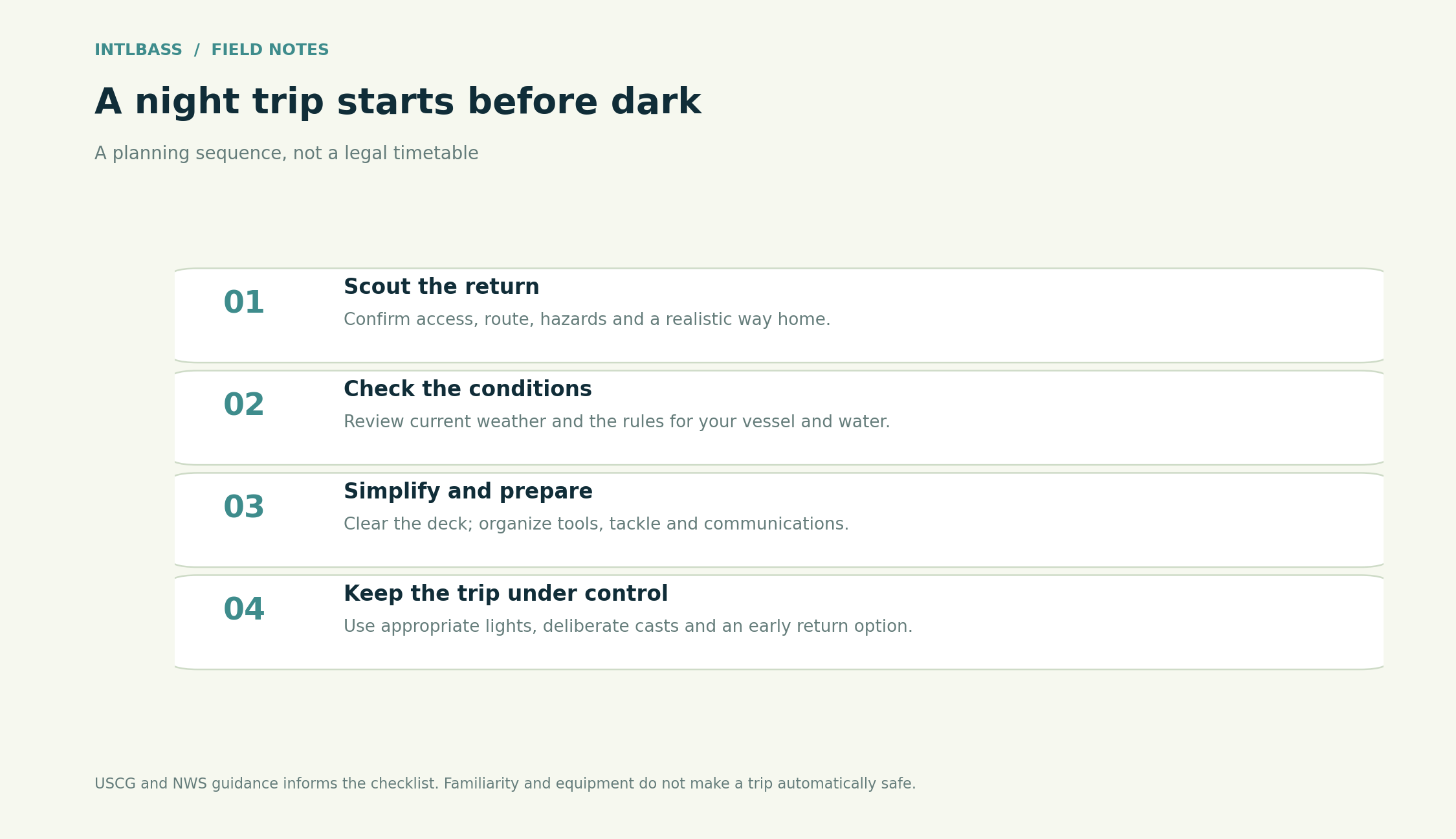
The sequence below illustrates an orderly workflow relative to sunset. This sequence is an organizational aid to ensure deliberate preparation, not a legal operational schedule.
- T minus 3 to 4 Hours (Site & Gear Inspection): Confirm legal access hours and parking regulations at your launch point. Check regional weather radar and local inland wind forecasts. Test vessel navigation light connections and inspect flashlight/headlamp battery reserves.
- T minus 1 to 2 Hours (Daylight Rigging): Arrive at the access point during daylight. Rig your two or three primary rods, tie fresh knots, set mechanical reel brakes, and stow spare gear securely in lockers or dry bags.
- Sunset to Dusk (Transition on Water): Turn on required vessel navigation lights as sunset occurs or visibility declines. Navigate to your first chosen structure while ambient light still allows visual orientation. Identify prominent shoreline markers and reference points for your eventual return route.
- Full Darkness (Controlled Session): Begin fishing high-percentage structure. Keep task lighting strictly downward-directed and use it only for necessary knot-tying or unhooking. Regularly re-check boat position and monitor local weather updates.

Tactile Retrieves, Strike Detection, and Landing Fish
Low light makes subtle line movement harder to see. Keep contact with the presentation where appropriate and watch for changes in weight or vibration. Confirm the situation without jerking an uncertain snag toward yourself or another angler. Match the hookset to the hook and tackle while maintaining a stable stance.
Have a landing plan and task light ready before the bite. Bring the fish alongside under control without deliberately exhausting it or swinging it across the deck. Use suitable wet handling surfaces, keep hook points away from hands, and support a brief release photo. Our fish-care guide explains the handling sequence.
Night Fishing Preparation Checklist
Before launching or heading down a shoreline path, verify each step on this practical preparation checklist:
- Access and parking regulations verified for legal post-dusk hours at your specific site.
- Current inland weather forecast reviewed, with a designated early-return threshold.
- USCG-compliant navigation lights checked, working, and ready for deployment from sunset to sunrise.
- Task lights (headlamp/flashlight) packed with fresh batteries and kept separate from vessel running lights.
- Deck and walking paths cleared of loose tackle, stray tools, and unlatched boxes.
- Rods limited to 2 or 3 essential setups, re-tied and checked for line abrasions during daylight.
- Controlled sidearm casting practiced, with casting brakes adjusted slightly tighter than daytime settings.
- Return route, ramp bearings, and shoreline hazards identified prior to total darkness.
Frequently Asked Questions
Can I use my headlamp as my vessel navigation light?
A headlamp does not automatically satisfy vessel navigation-light requirements. The applicable display depends on the craft and its operating status; particular rules for small vessels under oars may allow specified alternatives. Check the USCG Navigation Rules for your vessel rather than assuming a personal light is sufficient.
Do bass only strike dark-colored lures at night?
While dark colors like black, junebug, and dark blue are traditional staples because they create a sharp silhouette against ambient night sky illumination, bass rely heavily on their acoustic sense and lateral lines to detect water displacement. Vibration, water movement, and steady cadences are just as important as visual profile, though no single color or vibration style guarantees detection.
How do I avoid severe backlashes while casting in total darkness?
Follow your reel manufacturer’s setup guidance and practice controlled casts before dark. Additional braking may help on some baitcasting reels, but spool-tension settings are model-specific. Use short deliberate casts with a clear lane and stop when you cannot safely judge the space around you.
What should I do if a storm approaches after dark?
Do not wait for rain or lightning to become visible. Because cloud development cannot be monitored easily by eye at night, check mobile radar periodically. If high winds or convective storms are moving toward your location, immediately retrieve your lines, secure loose gear, exhibit your required navigation lights, and head back toward your launch point at a safe, controlled speed.
Leave a Reply