 International Bass Fishing™
THE DEPTH CHART / TECHNIQUE
The bite comes when the bait stops.
A jerkbait is a hard minnow you snap, twitch and stop. Get the depth, the cadence and the pause right, and it pulls bass up from cover in clear, cold or windy water when little else will. Here is how the baits differ on paper, how to work them by season, and what gear makes the job easier.
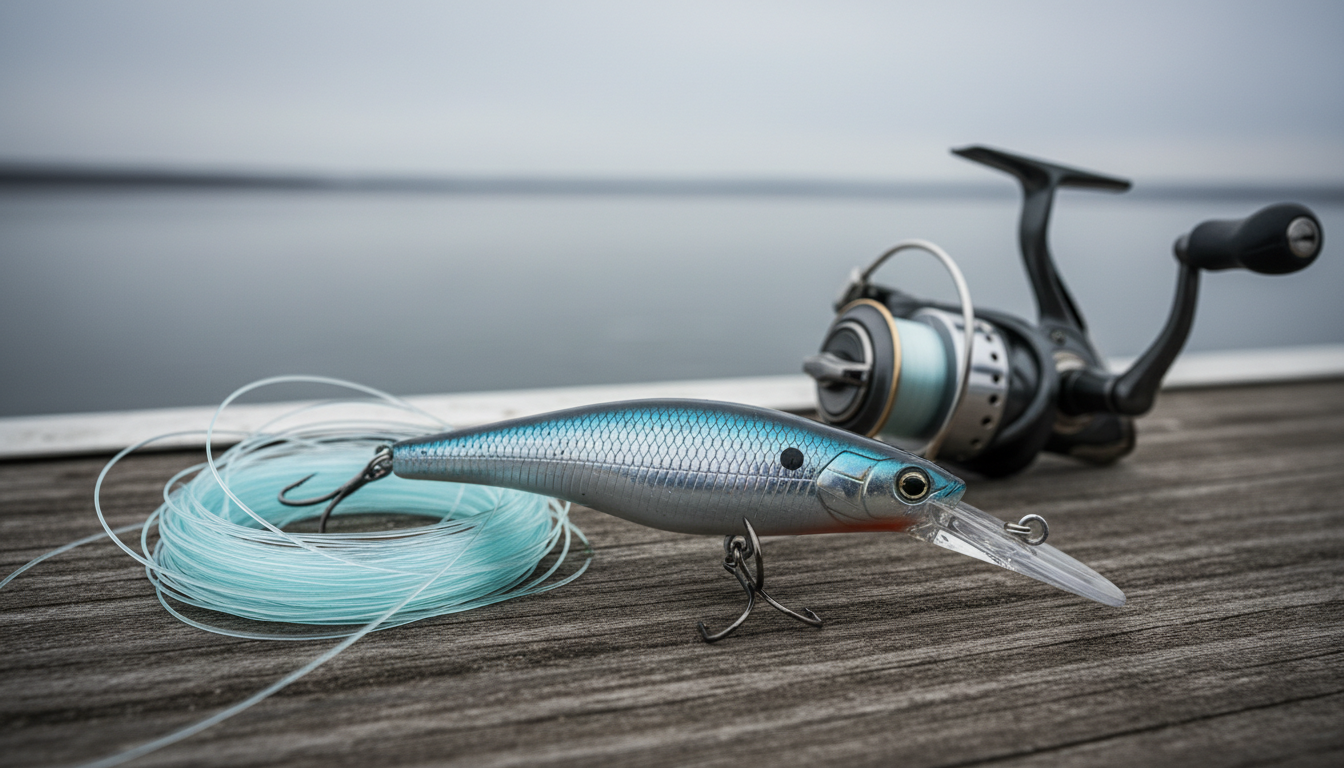
A jerkbait looks like the simplest lure in the box: a slim plastic or wooden minnow with a lip and two or three treble hooks. What makes it work is the angler. You snap the rod tip, the bait darts sideways, and then you stop. On a suspending model the bait hangs in place, and that pause is when many bass decide to eat.
This guide explains the main jerkbait types, uses manufacturers’ own published depths so you can choose the right bait for the water, and lays out cadence and gear choices drawn from pro and agency sources. The tactics are IntlBass guidance, not guarantees; jerkbait fishing rewards experimenting.

The basics
What a jerkbait is (and the three kinds)
Jerkbaits are long, thin minnow imitations with a short-to-medium lip. Unlike a crankbait you wind steadily, a jerkbait moves when you move the rod. Where it sits when you stop is what separates the types:
Hangs on the pause
Weighted to sit still at depth when you stop. Rapala lists the X-Rap XR10 as suspending and the Husky Jerk line as suspending or neutrally buoyant. This is the default cold-water jerkbait.
Fades on the pause
Rapala’s Shadow Rap is listed as slow sinking: on a pause it fades head-down, and on a sharp snap it kicks almost 180 degrees side to side with little forward travel.
Rises on the pause
A floating minnow drifts back up when you stop. It is useful over shallow grass or when you want a twitch-and-rise retrieve, but it gives up the hang time that makes suspending baits so effective in cold water.
Most jerkbaits carry two or three trebles. Use a lip gripper or pliers to unhook fish, keep the bait away from the fish’s head when it thrashes, and never hand-land a bass with a jerkbait swinging free near your fingers.

Depth
Running depth: what the spec sheets say
Depth is the first choice, because a jerkbait that runs above or below the fish does little. Manufacturers publish running depths, and they are the best starting point you have. Two caveats: listed depths assume typical line and cast length, and line diameter changes them. Megabass’s own US product page for the Vision 110 says it runs nearly 7 feet on 6 lb test but around 4 feet on 15 lb.
Listed running depths of popular jerkbaits
Feet. Gold = suspending (Rapala), teal = suspending (Megabass), orange = slow sinking. Megabass lists single depths: the 110 bar spans its line-size range (about 4 ft on 15 lb to nearly 7 ft on 6 lb); the 110+1 bar runs from the original’s 6 ft to its own 9 ft listing.
| Bait | Length | Weight | Listed depth | On the pause |
|---|---|---|---|---|
| Rapala X-Rap XR10 | 4 in | 7/16 oz | 4–6 ft | Suspends |
| Rapala Husky Jerk HJ10 | 4 in | 3/8 oz | 4–8 ft | Suspends / neutral |
| Rapala Husky Jerk HJ12 | 4-3/4 in | 7/16 oz | 4–8 ft | Suspends / neutral |
| Rapala Shadow Rap | 4-3/8 in | 7/16 oz | 2–4 ft | Slow sinks, head down |
| Rapala Shadow Rap Deep | 4-3/8 in | 7/16 oz | 4–8 ft | Slow sinks |
| Megabass Vision 110 | 4-1/3 in | 1/2 oz | 6 ft (about 4–7 by line) | Suspends |
| Megabass Vision 110+1 | 4-1/3 in | 1/2 oz | 9 ft | Suspends |
| Megabass Vision 110+2 | 4-1/3 in | 1/2 oz | 12–16 ft | Suspends |
Sources: Rapala X-Rap, Rapala Husky Jerk, Rapala Shadow Rap, Rapala Shadow Rap Deep, Megabass Vision OneTen, Megabass OneTen+1, Megabass OneTen+2 (US-market models; Megabass Japan lists its domestic OneTen as slow floating). We list these for comparison, not as endorsements.
Same bait, different line: Vision 110 running depth
Approximate feet. Thinner line has less drag, so the bait digs deeper.
The practical takeaway: pick the bait whose listed range brackets the depth where you expect fish, then fine-tune with line size. Many anglers prefer a bait that runs slightly above fish holding near cover, so it stays in view without fouling; treat that as a starting point, not a rule.
Technique
Cadence and the pause
Cadence is the rhythm of jerks and pauses. It is the variable you control most, and the one anglers argue about most. A few sourced starting points help narrow it.
Wired2Fish writer Sam Hanggi describes a species split: spotted bass often want fast, erratic jerks with little or no pause, while largemouth tend to prefer a slightly slower retrieve with intermittent pauses. For very cold water, veteran Ozarks angler Randy Blaukat, profiled in a second Wired2Fish article, says the biggest mistake he sees is overworking the bait, because bass tend to back off from too much erratic action and speed.
Water temperature is the other guide. Southern Regional Aquaculture Center says largemouth move less below 50°F, and the smallmouth habitat model notes fish turn inactive and seek shelter near 10 °C (50°F). A slower fish needs a longer look, which is why pauses stretch as water cools.
Cadence starting points by water temperature
Begin here, then change one variable at a time until fish respond.
| Water temp | Jerks per sequence | Pause length | Bait type |
|---|---|---|---|
| Below 45°F | 1–2 soft twitches | Long: several seconds or more | Suspending, silent |
| 45–55°F | 2 sharp jerks | Medium-long | Suspending |
| 55–65°F | 2–3 jerks | Short to medium | Suspending or slow-sinking |
| Above 65°F | 3+ fast, erratic | Short or none | Any; try floating over grass |
- Cast long and get it down. Make two or three hard pulls or fast turns of the reel to drive the bait to its running depth.
- Set the rhythm. Use the matrix as a start: for example, jerk-jerk-pause. Snap the rod tip down on slack line so the bait darts sideways rather than forward.
- Hold the pause. Count it out loud. Many anglers find strikes come on the pause or the next twitch; watch for the line to jump or go heavy.
- Take up slack between jerks, not during the pause. A little slack lets the bait move freely; too much and you will miss bites.
- Change one thing at a time. If nothing happens after several casts, lengthen the pause, then change the number of jerks, then change depth or bait.
- Repeat what worked. When a fish bites, note the count and repeat it exactly. That cadence often holds for the day.

Conditions
When and where jerkbaits shine
Hanggi says jerkbaits can be fished in all four seasons, with clear water one of the biggest deciding factors and wind almost always helpful. That lines up with how the bait works: bass find it by sight, so they need enough clarity to see it, and a chop breaks up the surface and makes fish less wary.
Sight-feeding fish
The bait relies on flash and movement. In stained water, try a louder or brighter model; in muddy water, a lure with more vibration may be the better call.
Banks and points taking the breeze
Fishery scientist Ralph Manns, writing in In-Fisherman, says a suspending jerkbait ripped just below the wave troughs can be very effective in strong wind.
Low light
Manns also calls light rain a good time for a jerkbait-and-topwater combination. See our weather guide.
Winter into prespawn
Blaukat fishes jerkbaits in water in the low 40s and down into the upper 30s. Fisheries biologist Hal Schramm says bass can be caught down to about 40°F. More in our cold-water guide.
Smallmouth waters are classic jerkbait water. Tennessee’s wildlife agency lists jerkbaits among the forage-imitating lures for Dale Hollow smallmouth, alongside crankbaits and jigs. Learn the species differences on our smallmouth, spotted bass and largemouth pages.
Gear
Rod, reel and line
Jerkbait gear has one job: let you snap the bait hard all day without tearing hooks out of fish or wearing out your wrist.
| Piece | Starting point | Why |
|---|---|---|
| Rod | About 7 ft, medium action, softer tip | Hanggi uses a 7-ft medium casting rod; he says a parabolic tip allows good hook sets without pulling the bait away from the fish |
| Reel | High gear ratio baitcaster, or spinning | Fast pickup between jerks; Blaukat uses spinning gear for long casts in cold water |
| Line | 10–12 lb fluorocarbon (lighter for depth) | Hanggi’s pick, and the sweet spot Megabass suggests for the Vision 110; thinner line lets the bait run deeper |
| Bait weight | Roughly 3/8 to 1/2 oz for 4-inch baits | Listed weights of the baits in the spec table above |
Sources: Wired2Fish: How to fish a jerkbait; Wired2Fish: ultracold-water jerkbait tips; manufacturer and retailer listings above.
Casting distance matters because a jerkbait has to dive before it starts working. Some baits move internal weights to help: TackleTour’s review of the Vision 110 describes two tungsten weights that slide toward the tail on the cast. Browse rods and reels on our gear page.
Prime jerkbait season overlaps with dangerous water. The National Center for Cold Water Safety says cold shock peaks in 50–60°F water. Maryland DNR’s advice is to wear a life jacket at all times and dress for the water, not the air.
Plan your trip
Plan a jerkbait trip
Wind and cloud cover are the two weather details that change a jerkbait day most. Use the live widget to check both at five bass waters, then pick the windward banks you can fish safely.
Live conditions
Wind and sky check for jerkbait water
Loading live conditions…
Air conditions from the Open-Meteo forecast model, refreshed when the page loads. This is not water temperature, a fishing forecast or a marine warning — check the National Weather Service and your lake operator before launching.
More waters live in our locations section, including Lake Norman, and tournament dates are on the schedule. For the bigger picture of when bass move shallow and deep, read the bass year by water temperature.
FAQ
Frequently asked questions
How long should I pause a jerkbait?
There is no fixed number. Start with short pauses in warm water and stretch them as the water cools; in very cold water, anglers often wait several seconds or longer. Let the fish tell you.
Suspending or slow-sinking?
Suspending baits hang at depth on the pause and are the usual cold-water choice. Slow-sinking baits like the Shadow Rap fade head-down, which can help when fish sit slightly deeper.
What line is best for jerkbaits?
Many anglers use 10–12 lb fluorocarbon. Thinner line lets the bait run deeper; Megabass says the Vision 110 runs nearly 7 ft on 6 lb test but around 4 ft on 15 lb.
Do jerkbaits work in summer?
Yes, especially in clear water and wind. Expect faster, more erratic cadences to work better as water warms.
Why do I keep missing fish on a jerkbait?
Often too much slack during the pause or a rod that is too stiff. Take up slack between jerks and use a rod with a softer tip.
Sources / review date
Built on sources you can check.
Reviewed October 17, 2026. Regulations, access and conditions change; confirm with the agency or operator before you go. Tactics are original IntlBass guidance, not guarantees. See our editorial standards; send corrections through Contact.
- Rapala: X-Rap — specs, suspending
- Rapala: Husky Jerk — specs, buoyancy
- Rapala: Shadow Rap — specs, action
- Rapala: Shadow Rap Deep — specs
- Megabass USA: Vision OneTen — specs, line vs depth
- Megabass USA: Vision OneTen+1 — specs
- Megabass USA: Vision OneTen+2 — specs
- Megabass Japan: VISION ONETEN — domestic model buoyancy
- TackleTour: Megabass Vision 110 review — weight-transfer system
- Wired2Fish: How to fish a jerkbait (Hanggi) — cadence by species, gear, conditions
- Wired2Fish: Jerkbait tips for ultracold water (Peterson) — Blaukat method
- Ralph Manns, In-Fisherman: Barometric pressure and bass — wind and rain tactics
- Hal Schramm, Mississippi Sportsman: Winter bass — cold-water feeding
- SRAC Pub. 200 — movement below 50°F
- Edwards, Gebhart & Maughan 1983, Habitat Suitability Information: Smallmouth Bass (USFWS FWS/OBS-82/10.36) — cold inactivity
- TWRA: Dale Hollow Reservoir — smallmouth lures
- KDFWR: Hendricks Creek access — ramp, location reference
- National Center for Cold Water Safety — cold shock
- Maryland DNR: Cold water boating — life jackets
- Lake Norman — coordinates
- Lake Fork Reservoir — location reference
- Lake St. Clair — coordinates
- Lake Kissimmee — coordinates
Leave a Reply